
Best Fixed Term Savings & Fixed Deposit Rates in the UK (Feb 2026)
Transparency Disclosure: To keep our guides free for everyone, this post contains affiliate links and display advertisements. If you click an affiliate link and sign up, we may earn a commission at no extra cost to you. As an ex-banker with 25 years of experience, I only recommend tools that I believe provide genuine value to your financial health. Read our full Affiliate Disclosure here.
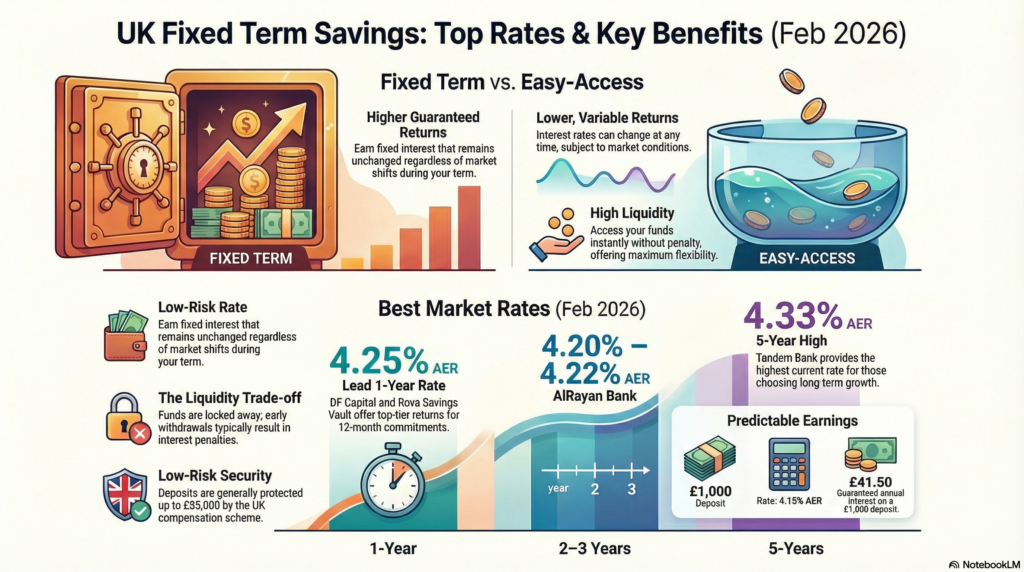
If you want your savings to earn more than they would in a normal current or easy-access account, a fixed term savings account (similar to a fixed deposit) could be a great option. These accounts offer guaranteed interest for a set period, helping your money grow steadily for your goals.
This guide explains how fixed term savings work and the best rates available in the UK in early 2026.
What Is a Fixed Term Savings Account?
A fixed term savings account (sometimes called a fixed rate bond) is a saving product where you agree to leave your money untouched for a fixed period, such as 1, 2, 3, or 5 years.
In return:
- The bank promises a fixed interest rate
- Your balance grows steadily
- You usually cannot withdraw without penalties
Because of this commitment, you typically earn higher interest than easy-access savings.
Why Choose a Fixed Term Account
These accounts are a good option when:
- You have money you don’t need immediately
- You want a guaranteed return
- You’re okay locking funds for a set time
They’re very low risk and often protected up to £85,000 (or higher) by the UK’s savings compensation scheme.
How Interest Works on Fixed Term Accounts
With a fixed term account:
- Your interest is agreed at the start
- It does not change until the term ends
- You know exactly how much you will earn
Example:
- Save £1,000 at 4.15% AER fixed for one year → you earn £41.50 interest before tax.
Best Fixed Term Savings Rates in the UK (Feb 2026)
Here are some of the most competitive rates available right now, based on recent market comparisons:
🔹 1-Year Fixed Accounts
- DF Capital / Rova Savings Vault – around 4.25% AER
- Typical market one-year rates – around 4.15% AER
🔹 2–3 Year Fixed Accounts
- AlRayan Bank Meteor Savings 2–3 yrs – about 4.20–4.22% AER
- Other fixed bonds for 3 yrs also around 4.20% AER on Moneyfacts data
🔹 Longer Term (4–5 Years)
- Tandem Bank 5-Year Fixed Saver – around 4.33% AER
- Longer fixed terms can offer similar or slightly higher guaranteed rates.
💡 In general, locking money away for longer often earns slightly higher interest, but be sure you don’t need access before the end of the term.
Fixed Term Savings vs Easy-Access Savings
| Feature | Fixed Term Savings | Easy-Access Savings |
| Interest rate | Higher & guaranteed | Lower & variable |
| Access to funds | Locked (penalties if withdrawn early) | Anytime |
| Best for | Medium-long term goals | Emergency fund |
| Ideal if | You don’t need the money soon | You need flexibility |
Tax on Interest
Interest earned on standard fixed term accounts is subject to tax if it exceeds your Personal Savings Allowance. However, if you’re a basic rate taxpayer (earning under £50,270), you usually have an allowance before tax applies. For details, please refer to “‘Tax on Savings Interest” posted on GOC.UK [Link].
If you want tax-free interest, consider a fixed term Cash ISA instead — rates are often similar but interest is protected from tax up to your ISA allowance.
Who Fixed Term Savings Are Best For
Fixed term accounts work well if:
- You have a lump sum you won’t need soon
- You want predictable returns
- You’re comfortable locking money away
They’re not ideal if:
- You might need money unexpectedly
- You prefer instant access
- You’re just starting to save small amounts
In those cases, easy-access savings or Cash ISAs might be better while you build up longer-term savings.
Final Thought
Fixed term savings accounts can be a smart step for your money in 2026 — especially as some of the best rates around 4.2 – 4.3% AER beat typical easy-access returns in the current market.
Like all things with savings, the key is matching your goals, timeline, and comfort with locking funds before choosing the best product.
Why Trust Bright Savings UK?
Bright Savings UK is run by a former banker with over 25 years of experience in the banking and financial services industry. Our goal is to help everyday people save smarter, with clear explanations and practical guidance.
Suggested Internal Links
- What Is a Bank Account? [Link]
- How does A Cash ISA work? [Link]
- Why Starting to Save at 18 Beats Saving More at 30 [Link]
📌 Note: Rates change often. Always check provider websites before opening an account.
How We Monetize This Site
To support the research and running of Bright Savings UK, we use two primary methods of monetization:
- Affiliate Links: Some links on this site are affiliate links. If you click and open an account, we may receive a commission. This does not change the price or terms you receive from the provider.
- Display Advertising: We host third-party advertisements through Google AdSense. We do not directly control the specific products shown in these ad units, and their presence does not constitute an endorsement by Bright Savings UK.
Disclaimer: This article is for educational purposes only and does not constitute financial advice. Always review provider terms directly before applying.