
Savings Accounts for Children in the UK: A Simple Guide for Parents (2026)
Transparency Disclosure: To keep our guides free for everyone, this post contains affiliate links and display advertisements. If you click an affiliate link and sign up, we may earn a commission at no extra cost to you. As an ex-banker with 25 years of experience, I only recommend tools that I believe provide genuine value to your financial health. Read our full Affiliate Disclosure here.
Saving for a child’s future is one of the most positive financial habits a family can build.
In the UK, there are several types of children’s savings accounts, each designed for different goals — from teaching money basics to building long-term savings.
This guide explains how children’s savings accounts work, the main options available, and how to choose the right one.
What Is a Children’s Savings Account?
A children’s savings account is a bank or building society account opened for a child, usually by a parent or guardian.
It allows you to:
- Save money in a child’s name
- Earn interest on those savings
- Teach children about money over time
Most accounts are designed for long-term saving, not daily spending.
Who Owns the Money?
This depends on the account type:
- Some accounts are managed by parents until the child reaches a certain age
- Others become legally owned by the child, who gains control at 16 or 18
It’s important to understand this before opening an account.
Main Types of Children’s Savings Accounts in the UK
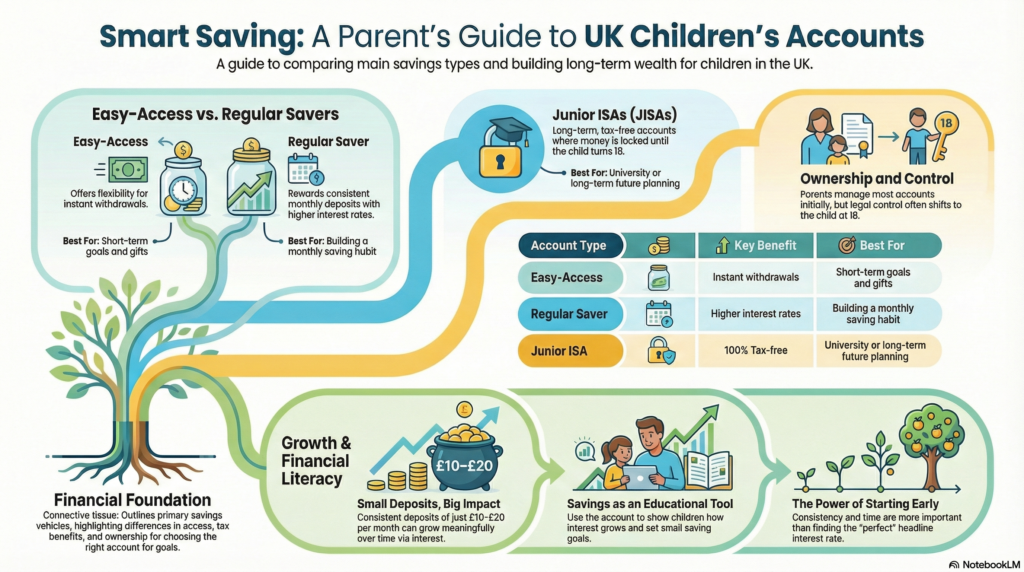
1️⃣ Children’s Easy-Access Savings Accounts
These are similar to adult savings accounts, but designed for under-18s.
Features:
- Money can usually be added or withdrawn easily
- Interest rates are variable
- Parent manages the account
Best for:
- Teaching children about saving
- Flexible short-term goals
- Gifts from family members
2️⃣ Regular Savings Accounts for Children
These accounts encourage monthly saving.
Features:
- Small monthly deposits (e.g. £10–£100)
- Often higher interest rates
- Limited flexibility
Best for:
- Building a saving habit
- Parents saving a little each month
3️⃣ Junior ISAs (JISAs)
A Junior ISA is a long-term, tax-free savings account for children.
Key points:
- Annual contribution limit applies
- Money is locked until the child turns 18
- Becomes an adult ISA at 18
- Interest is completely tax-free
Best for:
- Long-term savings
- University or future expenses
- Parents who won’t need access to the money
4️⃣ Savings in a Parent’s Account (Alternative Option)
Some parents choose to save in their own savings account instead.
Pros:
- Full control over money
- Flexible access
Cons:
- Interest may be taxable
- Money is not clearly separated for the child
This option works for families who want maximum flexibility.
How Much Should You Save for a Child?
There’s no “right” amount.
What matters most:
- Consistency
- Starting early
- Saving what you can afford
Even £10–£20 per month can grow meaningfully over time thanks to interest.
Teaching Children About Saving
Savings accounts can also be educational tools.
Simple ideas:
- Show them how interest grows
- Let them track balances
- Set small saving goals
- Explain why money is being saved
This builds healthy money habits early.
Common Mistakes to Avoid
❌ Locking all money away without flexibility
❌ Choosing an account without understanding access rules
❌ Chasing the highest rate without checking conditions
❌ Forgetting who controls the money at maturity
Understanding the rules matters more than the headline rate.
Which Option Is Best?
It depends on your goal:
- Short-term & flexibility → Children’s savings account
- Habit building → Regular saver
- Long-term future planning → Junior ISA
Many families use more than one option over time.
Final Thought
Children’s savings accounts aren’t about perfection — they’re about starting early and staying consistent.
The right account is the one that:
- Fits your family’s situation
- Matches your time horizon
- Helps build good financial habits
Why Trust Bright Savings UK?
Bright Savings UK is run by a former banker with over 25 years of experience in the banking and financial services industry. Our goal is to help everyday people save smarter, with clear explanations and practical guidance.
Suggested Internal Links
- What Is a Bank Account? [Link]
- How Does A Cash ISA Work? [Link]
- Why Starting to Save Early Matters [Link]
How We Monetize This Site
To support the research and running of Bright Savings UK, we use two primary methods of monetization:
- Affiliate Links: Some links on this site are affiliate links. If you click and open an account, we may receive a commission. This does not change the price or terms you receive from the provider.
- Display Advertising: We host third-party advertisements through Google AdSense. We do not directly control the specific products shown in these ad units, and their presence does not constitute an endorsement by Bright Savings UK.
Disclaimer: This article is for educational purposes only and does not constitute financial advice. Always review provider terms directly before applying.