
Junior ISA vs Children’s Savings Accounts: Which Is Better? (2026)
Transparency Disclosure: To keep our guides free for everyone, this post contains affiliate links and display advertisements. If you click an affiliate link and sign up, we may earn a commission at no extra cost to you. As an ex-banker with 25 years of experience, I only recommend tools that I believe provide genuine value to your financial health. Read our full Affiliate Disclosure here.
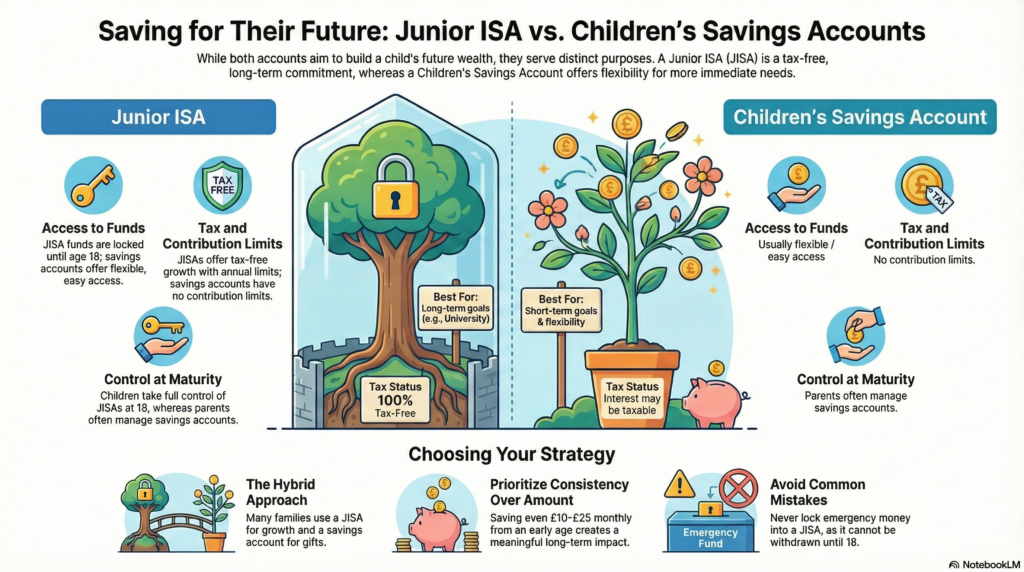
When saving for a child in the UK, two options often come up: Junior ISAs and Children’s Savings Accounts.
Both are designed to help build money for a child’s future — but they work in very different ways. This guide explains the key differences clearly, so you can decide which option fits your family’s goals.
What Is a Junior ISA?
A Junior ISA (JISA) is a long-term, tax-free savings account for children under 18.
Key features:
- Money is locked until the child turns 18
- Becomes an adult ISA at 18
- All interest and growth are tax-free
- Annual contribution limit applies
- Only parents or guardians can open it
Once opened, anyone (family, friends) can contribute.
What Is a Children’s Savings Account?
A Children’s Savings Account is a standard savings account designed for under-18s.
Key features:
- Parent or guardian manages the account
- Usually easy access to money
- Interest rates are variable
- No annual contribution limit
These accounts are more flexible than Junior ISAs.
Key Differences at a Glance
| Feature | Junior ISA | Children’s Savings Account |
| Access to money | Locked until age 18 | Usually flexible |
| Tax on interest | Tax-free | May be taxable |
| Contribution limit | Yes (annual limit) | No limit |
| Control at maturity | Child controls at 18 | Parent often controls |
| Best for | Long-term goals | Short-term & flexibility |
When a Junior ISA Makes Sense
A Junior ISA may be suitable if:
- You’re saving for long-term goals (university, future plans)
- You won’t need access to the money
- You want tax-free growth
- You’re comfortable with the child controlling the money at 18
This option rewards patience and consistency.
When a Children’s Savings Account Is Better
A children’s savings account may be better if:
- You want flexible access
- You’re saving for nearer-term expenses
- You want to teach children about money
- You prefer to stay in control
It’s often a good first step into saving.
Can You Have Both?
Yes.
Many families choose to:
- Use a Junior ISA for long-term savings
- Use a Children’s Savings Account for short-term goals or gifts
This balance offers both growth and flexibility.
Common Beginner Mistakes
❌ Locking emergency money into a Junior ISA
❌ Forgetting the child controls a JISA at 18
❌ Ignoring tax implications on large balances
❌ Choosing based only on interest rates
Understanding the rules matters more than chasing returns.
How Much Should You Save?
There’s no perfect number.
Even £10–£25 per month, started early, can make a meaningful difference over time.
Consistency matters more than amount.
Final Thought
Junior ISAs and children’s savings accounts serve different purposes.
- Choose a Junior ISA for long-term, tax-free growth
- Choose a Children’s Savings Account for flexibility and learning
The best option is the one that fits your family’s situation — not the one with the highest headline rate.
Why Trust Bright Savings UK?
Bright Savings UK is run by a former banker with over 25 years of experience in the banking and financial services industry. Our goal is to help everyday people save smarter, with clear explanations and practical guidance.
Suggested Internal Links
- Savings Accounts for Children in the UK [Link]
- How Does a Cash ISA Work? [Link]
- Why Starting to Save Early Matters [Link]
How We Monetize This Site
To support the research and running of Bright Savings UK, we use two primary methods of monetization:
- Affiliate Links: Some links on this site are affiliate links. If you click and open an account, we may receive a commission. This does not change the price or terms you receive from the provider.
- Display Advertising: We host third-party advertisements through Google AdSense. We do not directly control the specific products shown in these ad units, and their presence does not constitute an endorsement by Bright Savings UK.
Disclaimer: This article is for educational purposes only and does not constitute financial advice. Always review provider terms directly before applying.