
Is Wise Worth It for International Students in the UK? (2026 Review)
Transparency Disclosure: To keep our guides free for everyone, this post contains affiliate links and display advertisements. If you click an affiliate link and sign up, we may earn a commission at no extra cost to you. As an ex-banker with 25 years of experience, I only recommend tools that I believe provide genuine value to your financial health. Read our full Affiliate Disclosure here.
Moving to the UK as a student often means dealing with a lot of money questions:
- How do I receive money from home?
- Where can I transfer money cheaply?
- Can I send money internationally without losing value?
- Which service should I trust if I’m new to UK banking?
One service that pops up again and again is Wise [Link] — a fintech platform many international students use. But is Wise really worth it for students in the UK in 2026? This guide breaks it down simply, fairly and without jargon.
What Is Wise?
Wise is a financial technology company that offers:
✔ Multi-currency accounts
✔ Cheap international transfers
✔ Transparent exchange rates
✔ Debit cards and money management tools
Unlike traditional banks, Wise focuses on cheap, fair cross-border payments — something many international students need.
Why Wise Is Popular With Students
Here’s why Wise is often recommended in the UK:
1. Transparent Exchange Rates
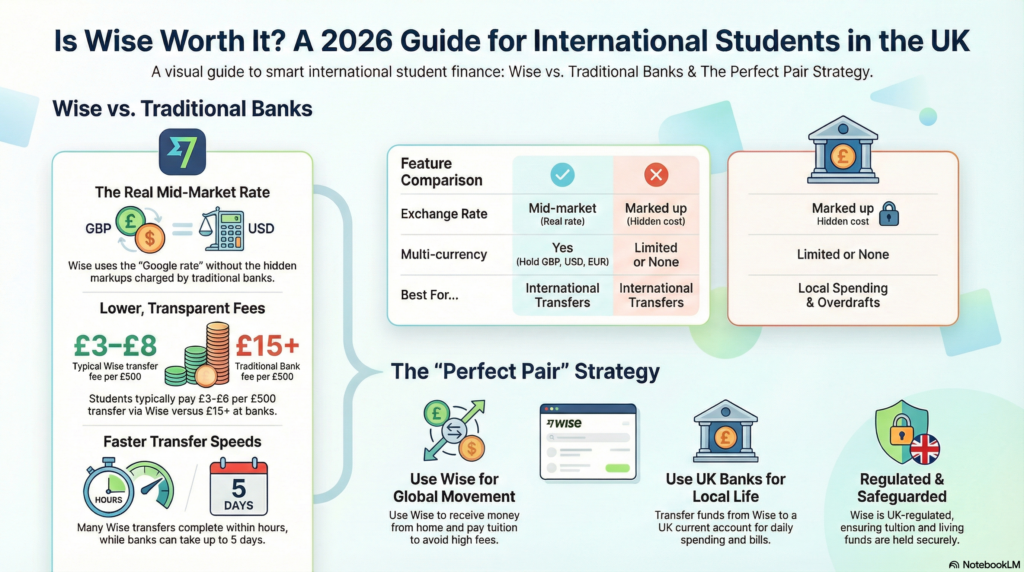
Wise uses the real mid-market rate — the same rate you see on Google — without hidden markups.
This matters when you’re converting money from another currency.
2. Low Fees on International Transfers
Traditional banks often charge:
- flat transfer fees +
- a markup on the exchange rate
That can add up — especially if you send money home regularly.
Wise shows you:
- upfront fees
- exact amount the recipient will get
No surprises.
3. Multi-Currency Account
With Wise you can hold money in multiple currencies:
- GBP (British pounds)
- USD (US dollars)
- EUR (Euros)
- And more
This is useful if you’re:
- paying tuition from overseas
- receiving money from family in different currencies
- travelling in Europe
4. Quick Transfers
Many Wise transfers complete within hours or on the same day, depending on the currency route — much faster than many traditional bank transfers.
Speed matters when you need money quickly.
How Much Does Wise Cost?
Wise is not free, but its fees are clear:
✔ A small fixed fee per transfer
✔ A percentage based on the amount
✔ No hidden markups
For students who send money from abroad, this often works out cheaper than using a bank or other services.
Wise vs Traditional UK Banks (Students)
| Feature | Wise | Traditional Banks |
| Exchange rate | Mid-market (best) | Often marked up |
| Fees | Low & transparent | High + hidden markup |
| Speed | Same day / hours | 1–5 days |
| Multi-currency | Yes | Limited |
| Mobile experience | Strong | Varies |
| Great for students? | 👍 Yes | 🤷 Depends |
When Wise Might Not Be the Best Option
Wise is excellent for:
- international money transfers
- holding multiple currencies
- cheap, transparent fees
But it might not be ideal if:
❌ You need full traditional banking services (e.g. UK current accounts, full payroll, overdrafts)
❌ You need branch access
❌ You prefer a bank where all accounts are under one roof
For day-to-day UK banking, you still need a UK current account — Wise doesn’t replace that.
How Wise Works With a UK Bank Account
A smart setup many students use:
- Open a UK current account (e.g. student account from a UK bank)
- Use Wise for international money movements
- Transfer funds from Wise → bank when needed
- Use your UK bank for everyday spending
This lets you:
- avoid heavy international transfer costs
- receive money cheaply
- spend locally without weird charges
Example: Wise Fees vs Bank Transfer
Let’s say you send £500 from abroad:
- Traditional Bank:
- Service fee: £15
- Exchange rate markup: 2–3%
- Recipient gets less after hidden costs
- Wise:
- Transparent fee: ~£3–£8
- Mid-market rate
- Recipient gets almost the full amount
This difference matters when you make repeated transfers — common for students.
Safety & Regulation
Wise is regulated in the UK and globally.
Funds are safeguarded or held with licenced banks — not used for Wise’s own operations.
That gives peace of mind if you’re handling tuition fees or living expenses from overseas.
Wise for Newcomers and International Students — Key Takeaways
✔ Worth it: If you’re sending or receiving international money
✔ Worth it: If you want fair exchange rates and clear fees
✔ Worth it: If you travel or study abroad frequently
✔ Not enough alone: It doesn’t replace a full UK bank account
✔ Perfect pairing: Wise + UK current account
How to Start With Wise (Friendly Guide)
- Go to Wise’s website [Link]
- Sign up with your email
- Verify your identity (passport/BRP)
- Add a funding source (your home country bank)
- Make your first transfer
If you’re planning international tuition payments or sending money home, review the fees first to know exactly what you’ll pay.
Final Verdict (2026)
Yes — Wise is worth considering if you’re an international student or newcomer to the UK who needs to:
- transfer money internationally cheaply
- hold multiple currencies
- avoid hidden bank fees
It’s a useful tool, but it works best alongside a regular UK bank account — not instead of one.
Why Trust Bright Savings UK?
Bright Savings UK is run by a former banker with over 25 years of experience in the banking and financial services industry. Our goal is to help everyday people save smarter, with clear explanations and practical guidance.
Suggested Internal Links
- How to Open a UK Bank Account Without a Utility Bill [Link]
- Best Student Bank Accounts 2026: Railcards & Sign-Up Bonuses [Link]
- How to Build a UK Credit Score From Scratch (2026 Guide) [Link]
How We Monetize This Site
To support the research and running of Bright Savings UK, we use two primary methods of monetization:
Display Advertising: We host third-party advertisements through Google AdSense. We do not directly control the specific products shown in these ad units, and their presence does not constitute an endorsement by Bright Savings UK.
Affiliate Links: Some links on this site are affiliate links. If you click and open an account, we may receive a commission. This does not change the price or terms you receive from the provider.
Disclaimer: This article is for educational purposes only and does not constitute financial advice.