
What is the Average ISA Savings in the UK by Age? (2026 Guide)
Transparency Disclosure: To keep our guides free for everyone, this post contains affiliate links and display advertisements. If you click an affiliate link and sign up, we may earn a commission at no extra cost to you. As an ex-banker with 25 years of experience, I only recommend tools that I believe provide genuine value to your financial health. Read our full Affiliate Disclosure here.
Individual Savings Accounts (ISAs) are one of the most powerful tax-free saving tools available in the UK. Whether you’re using a Cash ISA, Stocks & Shares ISA, Innovative Finance ISA, or Lifetime ISA, all investment growth and interest are tax-free.
But many people wonder:
How much do people actually have saved in their ISAs? And how does it compare by age?
Recent data from HMRC shows that ISA balances grow significantly as people get older — mainly because of long-term saving and compounding investment returns.
In this guide, we break down the average ISA savings in the UK by age, and what it means for your own financial planning.
Average ISA Savings in the UK by Age
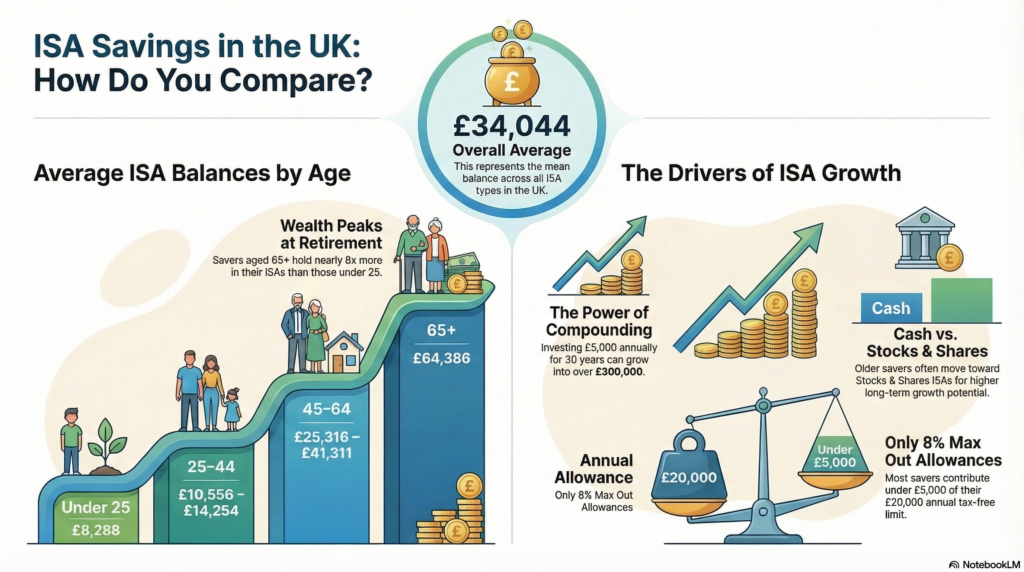
According to HMRC data, the average ISA balance across all account types is around £34,044.
However, balances vary widely depending on age.
| Age Group | Average ISA Savings |
| Under 25 | 8,288 |
| 25–34 | 10,556 |
| 35–44 | 14,254 |
| 45–54 | 25,316 |
| 55–64 | 41,311 |
| 65+ | 64,386 |
Source: HMRC Individual Savings Account Statistics, September 2025. [Link]
The pattern is clear:
- ISA savings increase steadily with age
- Older savers have had more years to contribute and benefit from investment growth
- Compounding returns significantly increase balances over decades.
Why ISA Savings Grow So Much With Age
There are three main reasons older savers typically have larger ISA balances.
1. Compounding Over Time
If someone invests £5,000 per year for 30 years, the total contributions would be £150,000.
But with modest investment returns (5–7%), the ISA balance could grow to £300,000+.
This is why starting early matters more than saving large amounts later.
2. Higher Income Later in Life
Many people save more in their 40s and 50s because:
- Salaries are higher
- Mortgages may be partly repaid
- Children may become financially independent
This allows savers to use more of the £20,000 annual ISA allowance.
3. Shift From Cash to Investments
Many younger savers start with Cash ISAs, while older savers increasingly use Stocks & Shares ISAs.
Historically, stock market investments have generated higher long-term returns than savings accounts, which helps ISA balances grow faster.
Average Contributions to ISAs Each Year
While the ISA allowance is £20,000 per year, most people contribute far less.
Recent data shows:
- Around 60% of ISA contributors deposit less than £5,000 annually
- Only about 8% of savers use the full £20,000 allowance.
This means many people are not fully using the tax-free opportunity available.
Which ISA Types Do People Use?
The UK currently offers several ISA types:
Cash ISA
- Works like a savings account
- Interest is tax-free
- Low risk
Stocks & Shares ISA
- Invest in funds, ETFs, and shares
- Higher long-term growth potential
- Market risk
Innovative Finance ISA
- Peer-to-peer lending investments
- Higher risk
Lifetime ISA (LISA)
- Government adds 25% bonus
- Used for first home purchase or retirement
Junior ISA
- Tax-free savings for children
- Up to £9,000 per year allowance
How Your ISA Savings Compare
If your ISA savings are around these levels, you are close to the UK average:
| Age | “Healthy” ISA Target |
| 20s | £8k–£10k |
| 30s | £10k–£15k |
| 40s | £15k–£25k |
| 50s | £25k–£40k |
| 60s+ | £40k–£60k+ |
These are general benchmarks, not strict rules. What matters most is consistent saving and investing over time.
The Power of Long-Term ISA Investing
ISA accounts have created thousands of long-term investors in the UK.
In fact, thousands of savers now hold ISA portfolios worth over £1 million, largely thanks to decades of tax-free compounding.
The key lesson:
👉 Start early
👉 Invest regularly
👉 Use your ISA allowance each year
Smart ISA Strategy for 2026
If you want to grow your ISA faster:
1. Use as much of your £20,000 allowance as possible
2. Consider combining Cash and Stocks & Shares ISAs
Example strategy:
| Goal | ISA Type |
| Emergency fund | Cash ISA |
| Long-term wealth | Stocks & Shares ISA |
| First home | Lifetime ISA |
Why Trust Bright Savings UK?
Bright Savings UK is run by a former banker with over 25 years of experience in the banking and financial services industry. Our goal is to help everyday people save smarter, with clear explanations and practical guidance.
Final Thoughts
ISA balances vary widely across the UK, but the overall trend is clear:
The earlier you start saving and investing, the bigger your ISA can grow.
Even small contributions in your 20s can potentially grow into six-figure tax-free investments later in life.
With the 2026 tax year ending soon, now is a good time to check:
- Have you used your ISA allowance this year?
- Are you making the most of tax-free investing?
✅ Related guides on Bright Savings UK
- Average Savings in the UK by Age (2026) [Link]
- The 6% Cash ISA War in the UK [Link]
- Last Chance: 7 Smart Things to Do Before the UK Tax Year Ends [Link]
How We Monetize This Site
To support the research and running of Bright Savings UK, we use two primary methods of monetization:
Display Advertising: We host third-party advertisements through Google AdSense. We do not directly control the specific products shown in these ad units, and their presence does not constitute an endorsement by Bright Savings UK.
Affiliate Links: Some links on this site are affiliate links. If you click and open an account, we may receive a commission. This does not change the price or terms you receive from the provider.
Disclaimer: This article is for educational purposes only and does not constitute financial advice. Always review provider terms directly before applying.
Pingback: Best Cash ISA, Savings & Fixed Deposit Rates UK – July 2026 | Bright Savings UK