
The 2026 Oil Spike: How to Protect Your UK Budget from the “Invisible Tax”
Transparency Disclosure: To keep our guides free for everyone, this post contains affiliate links and display advertisements. If you click an affiliate link and sign up, we may earn a commission at no extra cost to you. As an ex-banker with 25 years of experience, I only recommend tools that I believe provide genuine value to your financial health. Read our full Affiliate Disclosure here.
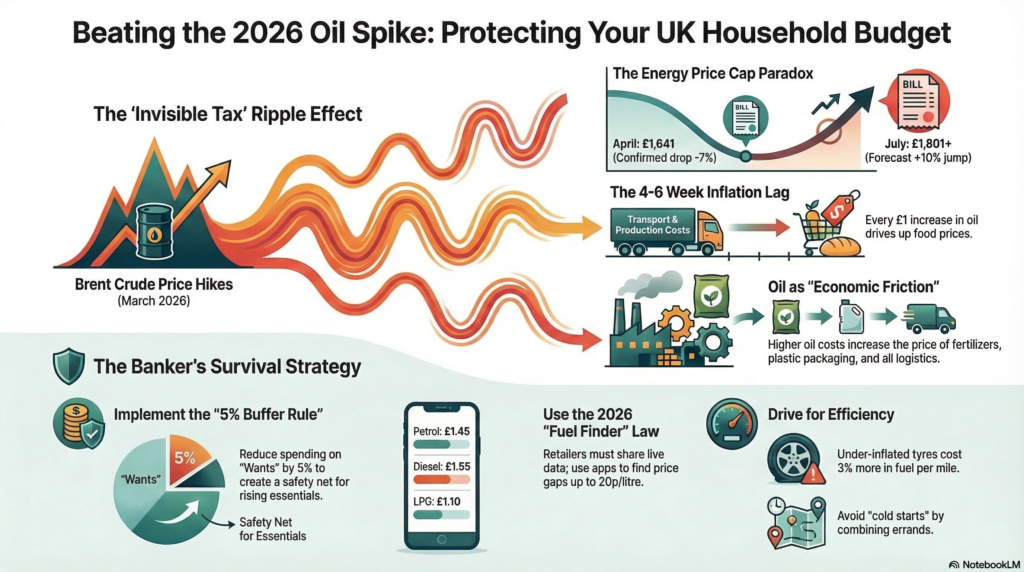
Oil prices have a “ripple effect” on the global economy. When Brent Crude surges—as we are seeing in March 2026—the impact spreads far beyond the petrol pump. It hits your groceries, your electricity, and even your standing charges.
For UK households already managing tight budgets, understanding this “Invisible Tax” is the first step to staying financially secure.
⚡ Key Takeaways for March 2026
- Energy Update: The Ofgem Price Cap falls to £1,641 on April 1st, but experts warn of a 10-15% jump in July due to Middle East volatility.
- Fuel Costs: Average unleaded is currently 136p/litre; diesel is 148p/litre.
- The “Invisible Tax”: Every £1 increase in oil can add to food inflation within 4-6 weeks as transport and production costs rise.
Why Oil Prices Matter for Your 2026 Budget
In my 25 years in banking, I’ve seen how oil acts as the “friction” of the economy. It isn’t just fuel; it is a core ingredient in:
- Fertiliser & Farming: Higher oil makes crops more expensive to grow.
- Manufacturing: Plastic packaging and synthetic fabrics are oil-based.
- Logistics: Everything in your Amazon basket or supermarket shelf was moved by a vehicle burning fuel.
1. The Energy Bill Paradox: Falling Now, Rising Later
While global oil prices are spiking, your energy bill is actually about to drop. Thanks to the 2025 Autumn Budget and the removal of “green levies,” the price cap is falling.
The 2026 Energy Price Cap Comparison (Standard Dual Fuel)
| Period | Annual Cap (Typical Use) | Change |
| Jan – March 2026 | £1,758 | +0.2% |
| April – June 2026 | £1,641 | -7% (Confirmed) |
| July – Sept 2026 | £1,801+ | +10% (Forecast) |
Banker’s Tip: Don’t spend the £10-£15 monthly saving you’ll see in April. Move it into a “Buffer Fund” now to prepare for the predicted July spike.
2. Beat the Pump: Using the 2026 “Fuel Finder” Law
As of February 2026, UK fuel retailers are legally required to share “live” pricing data. The price gap between stations in the same town can now be as high as 20p per litre.
- Avoid Motorways: They remain 15-20% more expensive.
- Supermarket Loyalty: In 2026, Nectar and Clubcard “Member Prices” for fuel are often the only way to get below the 130p mark.
- Live Data Apps: Use PetrolPrices or Waze, which now pull directly from the government’s mandatory “Fuel Finder” API.
3. The “Banker’s 5% Buffer” Strategy
When oil prices are volatile, I recommend a proactive budget adjustment.
If Brent Crude stays above $100/barrel, expect “lagged inflation” in your grocery shop. To counter this, use the 5% Buffer Rule:
- Identify your “Wants” (Subscriptions, dining out, etc.).
- Proactively reduce this category by 5%.
- Move that 5% into your “Essentials” or “Emergency” category.
- Result: You’ve created a safety net for rising costs before they actually hit your bank statement.
Practical Steps to Reduce the Impact
- Combine Your “Cold Starts”: Engines use significantly more fuel when cold. Doing three errands in one loop saves more than three separate trips.
- Check Your Tyres: Under-inflated tyres increase “rolling resistance,” costing you roughly 3% more in fuel every single mile.
- The “No-Idling” Rule: In 2026, many UK councils have increased fines for stationary idling. Turning off your engine for a 2-minute wait saves money and avoids a ticket.
- Consider Public Transport: Using trains, buses, or cycling for short trips can significantly reduce fuel expenses. Many cities offer discounted travel for students or commuters.
Final Thought
We cannot control the Strait of Hormuz or global oil markets, but we can control our “Personal Inflation Rate.” By using live data, building a small buffer, and driving efficiently, you can protect your financial progress even when prices are rising.
At Bright Savings UK, we help you understand the “Why” behind the numbers so you can master the “How” of your money.
Why Trust Bright Savings UK?
Bright Savings UK is run by a former banker with over 25 years of experience in the banking and financial services industry. Our goal is to help everyday people save smarter, with clear explanations and practical guidance.
Suggested Internal Links
- Best Ways to Save Money on Groceries in the UK [Link]
- The Most Important Investment in Life Is Your Health [Link]
- The 50/30/20 Budget Rule Explained for UK Beginners (2026 Guide) [Link]
How We Monetize This Site
To support the research and running of Bright Savings UK, we use two primary methods of monetization:
Display Advertising: We host third-party advertisements through Google AdSense. We do not directly control the specific products shown in these ad units, and their presence does not constitute an endorsement by Bright Savings UK.
Affiliate Links: Some links on this site are affiliate links. If you click and open an account, we may receive a commission. This does not change the price or terms you receive from the provider.
Disclaimer: This article is for educational purposes only and does not constitute financial advice. Always review provider terms directly before applying.