
Beyond the Page: A Banker’s Take on Rich Dad Poor Dad for the 2026 UK Saver
Transparency Disclosure: To keep our guides free for everyone, this post contains affiliate links and display advertisements. If you click an affiliate link and sign up, we may earn a commission at no extra cost to you. As an ex-banker with 25 years of experience, I only recommend tools that I believe provide genuine value to your financial health. Read our full Affiliate Disclosure here.
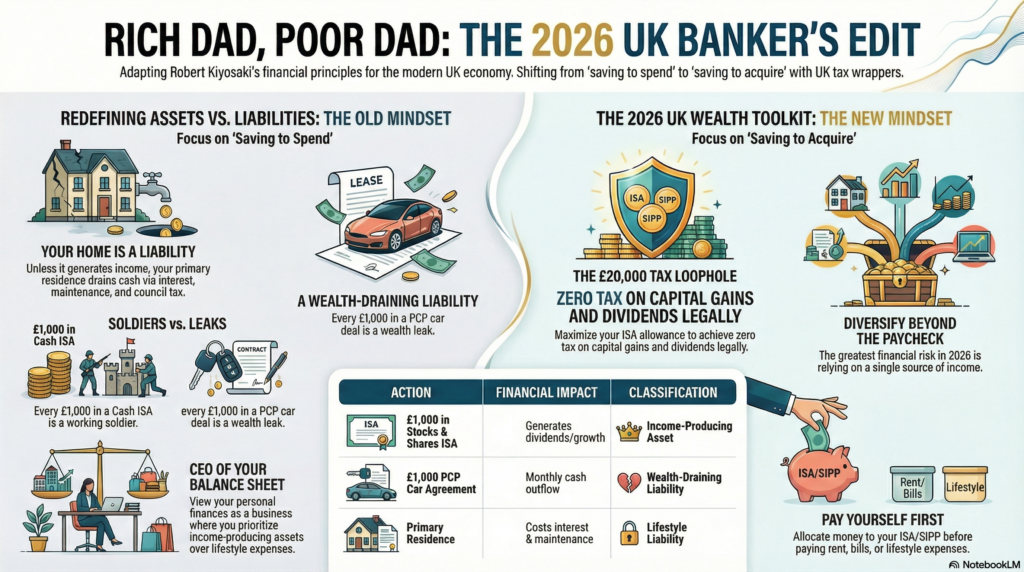
Personal finance books come and go, but few have had the lasting impact of Rich Dad Poor Dad by Robert Kiyosaki.
For many, it’s the first introduction to thinking differently about money.
But how do its ideas hold up in modern-day UK finance in 2026?
After more than 25 years in banking, here’s my practical take—what still works, what needs adapting, and how UK savers can apply it today.
The Core Shift: Assets vs. Liabilities
The most famous lesson in Rich Dad Poor Dad is simple:
👉 An asset puts money in your pocket. A liability takes money out.
Having reviewed thousands of balance sheets during my banking career, I can confirm:
👉 The biggest misconception among UK savers is this: “My home is my biggest asset.”
In reality:
- It may increase in value
- But it also costs:
- Mortgage interest
- Maintenance
- Insurance
- Council tax
👉 In Kiyosaki’s framework, your primary residence behaves more like a liability unless it generates income.
The 2026 Technique: From “Saving to Spend” → “Saving to Acquire”
Here’s how to apply this thinking today:
- Every £1,000 in a Cash ISA = a “soldier” working for you
- Every £1,000 spent on a PCP car deal = a “leak” draining your wealth
👉 The mindset shift: Stop saving just to spend—start saving to acquire income-producing assets.
Technique 1: Mind Your Own Business (The Side-Hustle Logic)
Kiyosaki’s idea:
- Your job pays your bills
- Your business builds your wealth
The Reality in the UK
Most people unknowingly work for:
- The bank (mortgage)
- The government (tax)
- Retailers (lifestyle spending)
The Banker’s Strategy (2026 Version)
You don’t need to start a company.
👉 Your “business” can be:
- A Stocks & Shares ISA portfolio
- Low-cost index funds
- Selective use of IFISAs (if you understand the risk)
Think of it this way:
👉 You are the CEO of your own balance sheet.
Technique 2: The “Tax Loophole” (UK Edition)
Kiyosaki emphasises using the system legally to reduce tax.
In the UK, we already have powerful tools:
- ISA (Individual Savings Account)
- Pension (SIPP)
Your 2026 Strategy
By using your £20,000 ISA allowance, you:
- Pay zero tax on gains
- Pay zero tax on dividends
👉 This is the UK version of: “The rich use the rules to their advantage.”
No offshore accounts needed—just discipline.
Technique 3: Financial Literacy Is the Real Edge
One of the most underrated lessons in the book:
👉 The difference between:
- “I can’t afford it”
- “How can I afford it?”
What Financial Literacy Really Means
It’s not just motivation—it’s understanding:
- Cash flow
- Risk
- Inflation
- Investment returns
Financial literacy is the ability to read numbers. If you can’t read a bank statement or understand how Inflationary Drag (use my ISA Calculator here!) eats your savings, you are at a disadvantage.
The ISA “Invisible Tax” Calculator
See how inflation eats your £20,000 allowance if your interest rate doesn’t keep up with the cost of living.
Average Cash ISA (2026)
UK Target is 2.0%
Your Wealth is Growing
In 10 years, your purchasing power will change.
Final Cash Value
£0
The number on your screen
Real Value (Adjusted)
£0
Actual purchasing power
Inflation Loss
£0
Lost to rising costs
🏦 Banker’s Insight
Most savers only look at the “Final Cash Value.” But if your inflation rate is higher than your interest rate, you are effectively paying an Invisible Tax. To protect your £20k allowance, your total yield must exceed CPI. This is why many 2026 investors are moving a portion of their ISA into Stocks or IFISAs to bridge the gap.
Note: This calculator is for educational purposes only and uses simplified annual compounding. Real-world inflation and interest rates fluctuate.
Banker’s Insight
After 25 years in risk management, I can tell you:
👉 The biggest risk is NOT the stock market.
👉 The biggest risk is: Having only one source of income—your job.
How to Start Today (The Bright Savings UK Action Plan)
1. Audit Your “Leaks”
List your monthly spending:
- Which expenses generate value?
- Which simply drain cash?
2. Pay Yourself First
Before paying:
- Rent
- Bills
- Lifestyle
👉 Allocate money to your ISA first.
Even £200/month builds momentum.
3. Build Your Asset Base
Start simple:
- Cash ISA (stability)
- Stocks & Shares ISA (growth)
Add IFISA only if:
- You understand the risks
- You can tolerate losses
4. Invest in Financial Education
If you don’t understand:
- ISA types
- Inflation impact
- Risk vs return
👉 You’re at a disadvantage.
Knowledge compounds just like money.
Final Thought
Rich Dad Poor Dad is not a “get rich quick” guide.
It’s a way of thinking.
In today’s 2026 UK economy, the principles still apply—but must be adapted with:
- ISAs
- Modern investing tools
- Realistic risk management
💡 Bright Savings UK Tip:
Your most valuable asset isn’t your house or your savings account.
👉 It’s your ability to understand how money works—and make it work for you.
Why Trust Bright Savings UK?
Bright Savings UK is run by a former banker with over 25 years of experience in the banking and financial services industry. Our goal is to help everyday people save smarter, with clear explanations and practical guidance.
Suggested Internal Links
- Average Wealth in the UK by Age [Link]
- The Most Important Investment in Life Is Your Health [Link]
- How Many ISA Millionaires Are There in the UK? (2026 Guide) [Link]
How We Monetize This Site
To support the research and running of Bright Savings UK, we use two primary methods of monetization:
- Affiliate Links: Some links on this site are affiliate links. If you click and open an account, we may receive a commission. This does not change the price or terms you receive from the provider.
- Display Advertising: We host third-party advertisements through Google AdSense. We do not directly control the specific products shown in these ad units, and their presence does not constitute an endorsement by Bright Savings UK.
Disclaimer: This article is for educational purposes only and does not constitute financial advice. Always review provider terms directly before applying.