
Is Premium Bonds Worth It in 2026? The Real Odds Explained
Transparency Disclosure: To keep our guides free for everyone, this post contains affiliate links and display advertisements. If you click an affiliate link and sign up, we may earn a commission at no extra cost to you. As an ex-banker with 25 years of experience, I only recommend tools that I believe provide genuine value to your financial health. Read our full Affiliate Disclosure here.
Premium Bonds have long been a uniquely British way to save. Backed by the government and offering tax-free prizes, they appeal to millions of savers.
But in 2026, with savings rates rising and new platforms offering competitive returns, many are asking:
👉 Are Premium Bonds still worth it?
Let’s break down the real odds, returns, and whether they deserve a place in your savings strategy.
🏦 What Are Premium Bonds?
Premium Bonds are issued by NS&I (National Savings & Investments) [Link].
Instead of earning interest:
- Your money enters a monthly prize draw
- You can win between £25 and £1 million
Key features:
- Minimum investment: £25
- Maximum holding: £50,000
- Prizes are tax-free
- Backed 100% by the UK government
👉 Capital is secure—but returns are not guaranteed
🎲 The Real Odds (2026)
As of 2026:
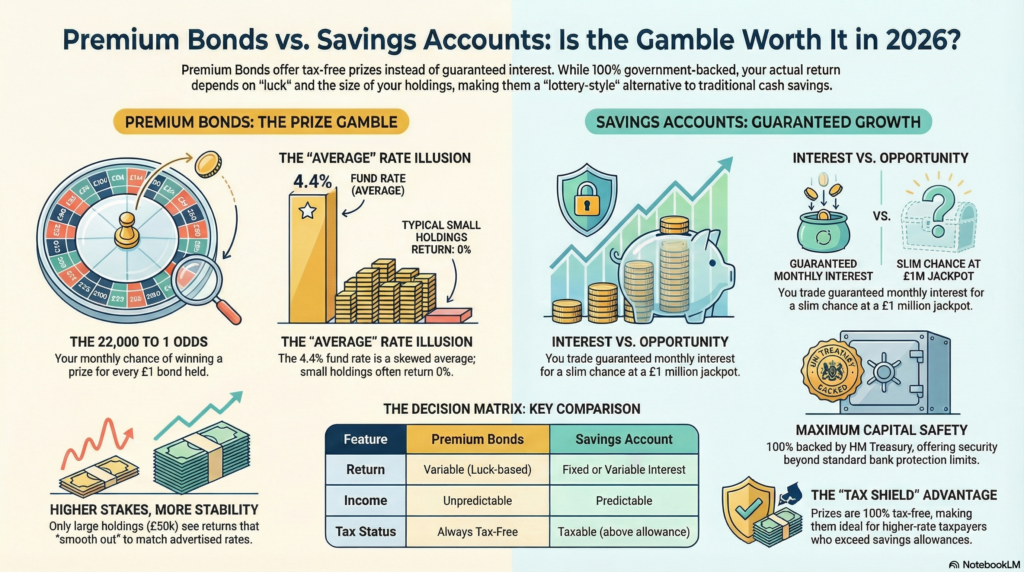
- Odds of winning per £1 bond: around 22,000 to 1 per month
That means:
- Holding more bonds = higher chance of winning
- But no guarantee of any return
📊 What Is the “Average” Return?
NS&I publishes a prize fund rate (similar to an interest rate):
👉 Around 4.0%–4.4% (variable) in recent periods
BUT this is where many savers misunderstand.
Important:
👉 This is not what you personally will earn
It’s an average across all bondholders.
⚠️ The Reality: Your Actual Return May Be Much Lower
Let’s look at realistic outcomes:
Small holdings (£1,000–£5,000):
- You may win nothing for months (or years)
- Effective return could be 0%
Medium holdings (£10,000–£25,000):
- Occasional small wins (£25–£100)
- Return may be 1%–3%
Large holdings (£50,000):
- More consistent wins
- Closer to advertised rate (but still not guaranteed)
💰 Premium Bonds vs Savings Accounts (2026)
| Feature | Premium Bonds | Savings Account |
| Return | Variable (luck-based) | Fixed/variable interest |
| Risk | Very low (government-backed) | Very low (FSCS protected) |
| Income | Unpredictable | Predictable |
| Tax | Tax-free | Taxable (above allowance) |
| Liquidity | Easy access | Easy access |
👉 The key difference:
Premium Bonds = lottery-style returns
Savings account = guaranteed interest
🧠 The Banker’s Perspective
After 25+ years in banking, here’s the reality:
👉 Premium Bonds are not an “investment”
👉 They are a cash alternative with a lottery element
You are effectively trading:
- Guaranteed interest
for - A chance of higher (but uncertain) returns
🎯 When Premium Bonds Make Sense
They can be useful if:
✅ You are a higher-rate taxpayer
- Tax-free prizes become more attractive
✅ You value capital safety
- 100% backed by the UK government
✅ You enjoy the “lottery factor”
- Potential for large wins
🚫 When They Don’t Make Sense
Avoid relying on Premium Bonds if:
❌ You need predictable income
❌ You have small savings
❌ You want to maximise returns
👉 In many cases, a top savings account will outperform them.
📉 The Opportunity Cost (Often Ignored)
Example:
- £10,000 in Premium Bonds
- vs 4.5% savings account
👉 Savings account earns:
- £450/year (guaranteed)
👉 Premium Bonds:
- Could earn more… or £0
🛡️ Safety: Are Premium Bonds Secure?
Yes—this is one of their biggest advantages.
- Backed by NS&I
- No FSCS limit required
- Capital is fully protected
👉 They are among the safest places to hold cash in the UK.
⚖️ Final Verdict: Are Premium Bonds Worth It in 2026?
👉 Yes—but only in the right context
Best used as:
- A low-risk cash holding
- A diversification tool
- A fun alternative to savings
Not ideal for:
- Maximising returns
- Building wealth quickly
- Replacing interest-paying accounts
The Insight: Most savers will actually earn less than the advertised 4.4% because the big prizes pull the average up. In banking, we call this a “skewed distribution.” If you have £1,000, your most likely return is 0%. If you have £50,000, your return starts to “smooth out” and look more like a standard savings account.
🛑 The “Higher Rate” Decision Point
- Basic Rate Taxpayer (£1,000 Personal Savings Allowance): You can earn £1,000 in interest tax-free. At 5% interest, you’d need £20,000 in savings before you pay a penny in tax. Verdict: A high-yield savings account (like those on Raisin) usually beats Premium Bonds.
- Higher Rate Taxpayer (£500 Allowance): You hit the tax limit much faster. Verdict: Premium Bonds become a “Tax Shield.” This is where the NS&I safety starts to outshine the competition.
✅ Bright Savings UK Verdict
Premium Bonds are:
👉 Safe but unpredictable
They suit savers who:
- Want security
- Don’t rely on steady income
- Are happy trading certainty for chance
- Higher Rate Taxpayer
💡 Bright Savings UK Tip:
A smart strategy is to split your cash:
- Keep some in high-interest savings
- Put some in Premium Bonds for upside potential
Why Trust Bright Savings UK?
Bright Savings UK is run by a former banker with over 25 years of experience in the banking and financial services industry. Our goal is to help everyday people save smarter, with clear explanations and practical guidance.
Suggested Internal Links
- How AI ‘Self-Driving’ Wealth Tools Can Save You £500 a Year (2026 Guide) [Link]
- Trading 212 vs XTB: The Battle for the 2026 UK ISA Crown [Link]
- Raisin and Other Savings Platforms in the UK: How They Work, Pros and Cons [Link]
How We Monetize This Site
To support the research and running of Bright Savings UK, we use two primary methods of monetization:
- Affiliate Links: Some links on this site are affiliate links. If you click and open an account, we may receive a commission. This does not change the price or terms you receive from the provider.
- Display Advertising: We host third-party advertisements through Google AdSense. We do not directly control the specific products shown in these ad units, and their presence does not constitute an endorsement by Bright Savings UK.
Disclaimer: This article is for educational purposes only and does not constitute financial advice. Always review provider terms directly before applying.