
The £500 Weekend Challenge: How to Audit Your Finances in 2 Hours
Transparency Disclosure: To keep our guides free for everyone, this post contains affiliate links and display advertisements. If you click an affiliate link and sign up, we may earn a commission at no extra cost to you. As an ex-banker with 25 years of experience, I only recommend tools that I believe provide genuine value to your financial health. Read our full Affiliate Disclosure here.
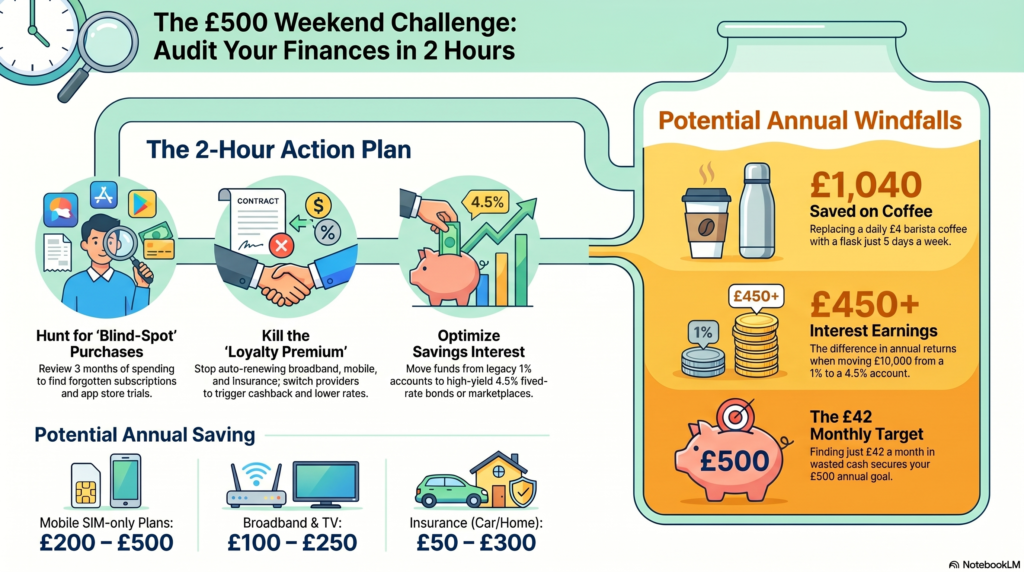
Most people think that improving their financial situation requires a few things they simply don’t have: complicated spreadsheets, expert investing knowledge, or months of soul-crushing sacrifice.
In reality, many UK households could easily free up £500 or more per year simply by spending two focused hours reviewing their numbers on a Sunday morning.
No lifestyle overhaul required. Just a bit of financial detective work.
The Idea Behind the Challenge
As a former banker with over 25 years in financial services, I’ve noticed a common pattern throughout my career:
People rarely lose control of their money because they earn too little. They lose it due to small financial leaks that build up quietly over time.
This guide is designed to help you perform a simple personal finance audit in one weekend. There is no advanced maths or accounting degrees needed here—just practical, real-world money management.
Why Most People Never Audit Their Finances
Businesses review their finances constantly to stay profitable. Yet, as individuals, we often fall into a routine of passive spending. We:
- Never check our active subscriptions.
- Let insurance policies auto-renew without checking the market.
- Leave hard-earned cash sitting in low-interest savings accounts.
- Ignore the gradual creep of our daily spending patterns.
The result? Money quietly disappears from your bank account every single month.
Even Small Amounts Matter
A £10 streaming service you forgot about, a £20 gym membership you haven’t used since January, a legacy mobile contract that ended two years ago…
Over a year, these micro-leaks easily total hundreds of pounds.
The Goal of the £500 Weekend Challenge
The premise is simple: Find £500 in annual savings within 2 hours.
That breaks down to finding just £42 a month in wasted cash. For most UK households, this is not just achievable—it’s a conservative target.
Grab a cup of tea, open up your laptop, and let’s get started.
Your Step-by-Step 2-Hour Audit
Step 1: Review Your Last 3 Months of Spending (30 Minutes)
Log into your banking apps, credit card statements, and digital wallets (like PayPal or Apple Wallet). You are looking specifically for recurring outgoings and “blind-spot” purchases.
- Look for: Forgotten subscriptions, duplicate streaming services, app store trials that rolled into paid memberships, and “convenience spending” (like mid-week takeaways).
- Common Financial Leaks:
- Streaming Services: Do you really need Netflix, Disney+, Prime, and Now TV all at once? Potential saving: £10–£40/month.
- The Convenience Tax: Buying a £4 barista coffee 5 days a week adds up to £1,040 a year. You don’t have to quit coffee but switching to a nice reusable flask just two days a week claws back massive chunks of cash.
Step 2: Audit Your Bills—And Double Your Savings with Cashback (30 Minutes)
In the UK, loyalty rarely pays. If you have been with your broadband, mobile, or insurance provider for more than 12 months, you are almost certainly paying an artificial “loyalty premium.”
But here is the insider trick: Don’t just switch or re-negotiate. Earn money for doing it.
Before you cancel or change any service, log into a cashback platform. My absolute go-to is TopCashback. Retailers pay them a commission for sending customers their way, and TopCashback passes 100% of that money straight back to you. When you combine a cheaper monthly tariff with a massive lump-sum cashback payout, your annual savings double instantly.
💡 Bright Savings UK Bonus: If you don’t have an account yet, you can sign up to TopCashback here using our exclusive link. It’s completely free to join, and you’ll score an extra new-member bonus just for getting started.
Look at these high-value areas during your 30-minute bill audit:
- Broadband & TV: Call your provider to negotiate or use a comparison tool. Switching providers frequently triggers huge windfalls. On top of a cheaper monthly rate, broadband providers on TopCashback regularly offer between £50 to £150 in pure cashback just for signing up.
- Potential saving: £100–£250/year.
- Mobile SIM Plans: Is your handset fully paid off? Drop that expensive contract immediately and switch to a SIM-only deal (like Smarty, Giffgaff, or Lebara). You can easily find plans for less than £10 a month, often with an extra £10–£30 cashback bonus attached.
- Potential saving: £200–£500/year.
- Insurance Renewals: Never, ever let car, home, or pet insurance auto-renew. Use comparison sites exactly 3 weeks before your renewal date for the best prices. Then, check TopCashback before buying the policy to claw back an extra 10% to 20% of your premium.
- Potential saving: £50–£300/year.
Step 3: Check Your Savings Interest Rate—And Claim a Free £100 Boost (15 Minutes)
Is your emergency fund working for you? Many traditional high street banks still pay insulting interest rates of 1% to 1.5% on standard savings accounts. If you leave your cash there, inflation is actively eating your purchasing power.
Moving your money is an easy win, but many people don’t do it because they hate the hassle of opening five different bank accounts to chase the best rates.
This is where a savings marketplace like Raisin UK is a complete gamechanger. Raisin is a free platform that lets you access hundreds of competitive savings accounts, notice accounts, and fixed-rate bonds from dozens of banks—all through one single login. You open one Raisin account, and you can spread or move your money across different banks with a single click. No more endless paperwork.
Even better, they have a fantastic incentive to help you jumpstart your savings audit.
💡 Bright Savings UK Bonus: If you sign up to Raisin UK using our exclusive referral link here and open and fund a fixed-rate bond (1 year or longer) with at least £10,000, you will receive a £100 cash bonus paid directly into our accounts.
Let’s look at the maths of what a quick 15-minute switch can do for you:
- The Math: If you have £10,000 sitting in a high-street legacy account paying 1%, you earn just £100 a year. Moving that same £10,000 to a top-tier 1-year fixed bond on Raisin paying 4.5% earns you £450 in interest.
- The Result: Add your £100 Raisin sign-up bonus to that new interest, and you have just turned a measly £100 return into a £550 windfall in your first year.
Potential impact: £350+ in extra annual interest, plus an instant £100 bonus.
Step 4: Review Debt Interest Rates (20 Minutes)
High-interest debt is the ultimate financial leak. Take a cold, hard look at the interest rates (APRs) on your:
- Credit cards
- Overdrafts
- Store cards or personal loans
If you are paying 20%–30% interest on a credit card balance, look into a 0% balance transfer card to freeze the interest while you pay it off. If you are regularly in your overdraft, speak to your bank about restructuring it into a lower-cost personal loan. Prioritising the elimination of high-interest debt is the fastest way to improve your financial health.
Step 5: Create a Simple Financial Snapshot (15 Minutes)
You don’t need a complex ledger. Just grab a piece of paper or open a basic spreadsheet and fill in these five numbers to get total clarity on where you stand each month:
| Category | Monthly Amount |
| Total Income (Take-home pay) | £ |
| Essential Bills (Mortgage/Rent, Council Tax, Utilities) | £ |
| Debt Payments (Minimums + Overpayments) | £ |
| Savings & Investing | £ |
| Discretionary Spending (Food, Fun, Clothes) | £ |
Step 6: Set 3 Immediate Actions (10 Minutes)
An audit without action is just a maths exercise. Look at what you’ve uncovered and pick three realistic things you can do today.
Examples include:
- Cancelling that unused gym or magazine subscription.
- Opening a higher-yield savings account and setting up a standing order to it on payday.
- Calling your broadband provider to negotiate a lower monthly rate.
The Psychology Behind Financial Audits
Taking control of your money isn’t about deprivation; it’s about intentionality.
During my 25 years in banking, I worked with thousands of clients. The individuals who enjoyed the most financial stability weren’t necessarily the ones making the highest salaries. They were the ones who were organized, consistent, and proactive.
When you know exactly where your pence and pounds are going, the anxiety surrounding money melts away. You replace worry with control.
Final Thoughts
You do not need a perfect budget, extreme frugality, or risky investment strategies to dramatically improve your financial position this weekend. Sometimes, the biggest wealth builders are the simplest: paying attention and plugging the leaks.
Why Trust Bright Savings UK?
Bright Savings UK is run by a former banker with over 25 years of experience in the banking and financial services industry. Our goal is to help everyday people save smarter, with clear explanations and practical guidance.
Suggested Internal Links
- Best Cash ISA, Savings & Fixed Deposit Rates UK – May 2026 [Link]
- Get Paid to Shop: Earn Cashback Instantly with JamDoughnut [Link]
- Raisin and Other Savings Platforms in the UK: How They Work, Pros and Cons [Link]
How We Monetize This Site
To support the research and running of Bright Savings UK, we use two primary methods of monetization:
- Affiliate Links: Some links on this site are affiliate links. If you click and open an account, we may receive a commission. This does not change the price or terms you receive from the provider.
- Display Advertising: We host third-party advertisements through Google AdSense. We do not directly control the specific products shown in these ad units, and their presence does not constitute an endorsement by Bright Savings UK.
`Disclaimer: This article is for educational purposes only and does not constitute financial advice.Investing involves risk. Capital is at risk, and you may lose money. Always review provider terms directly before applying.