
How to Prepare Your Finances Before Applying for Credit
Transparency Disclosure: To keep our guides free for everyone, this post contains affiliate links and display advertisements. If you click an affiliate link and sign up, we may earn a commission at no extra cost to you. As an ex-banker with 25 years of experience, I only recommend tools that I believe provide genuine value to your financial health. Read our full Affiliate Disclosure here.
Whenever you apply for a mortgage, credit card, car finance agreement, or personal loan in the UK, it can feel like your financial future is being decided by a mysterious algorithm.
You submit your details, wait nervously, and then receive a simple answer:
- approved
or - declined
As a former banker with over 25 years of experience in credit risk and financial services, I can tell you something important:
👉 It is far less mysterious than most people think.
Banks are not searching for “perfect” people.
They are looking for:
- predictability
- affordability
- stability
- responsible financial behaviour
Every lender has its own internal scoring system, but most decisions are built around the same core principles.
Understanding these principles can significantly improve your chances of approval.
🏦 What Banks Really Look At
When a lender reviews your application, they are essentially asking one question:
“How likely is this person to repay us on time?”
To answer that, they analyse several areas of your financial life.
1. Income, Debt & Affordability
Many people assume:
👉 “I earn a good salary, so approval should be easy.”
But lenders care less about how much you earn and more about:
👉 how much financial pressure you already carry.
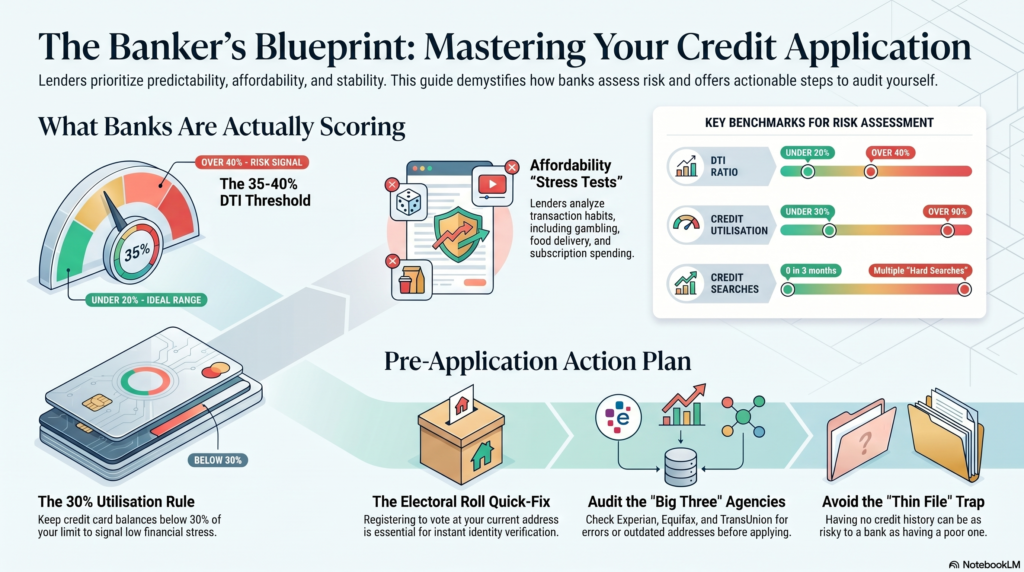
The Debt-to-Income Ratio (DTI)
Banks calculate your DTI ratio to assess how much of your monthly income already goes toward debt commitments.
This includes:
- credit cards
- loans
- car finance
- student loans
- overdrafts
Example:
Monthly take-home pay:
£3,000
Monthly debt payments:
£600
DTI ratio:

Generally:
- lower DTI = lower risk
- higher DTI = greater financial stress
Many lenders become cautious once unsecured debt commitments move above roughly 35–40% of income.
The Affordability Stress Test
Modern UK lenders now perform detailed affordability checks.
They do not simply review:
- salary
- rent
- utility bills
They also analyse spending behaviour.
This may include:
- gambling transactions
- heavy food delivery spending
- Buy Now Pay Later usage
- frequent overdraft reliance
- childcare costs
- subscription spending
Banks increasingly use transaction analysis tools to understand:
👉 how you actually manage money.
2. Your Credit Report (Not Just Your “Credit Score”)
This is where many people misunderstand the process.
The number shown on your credit app is NOT the score banks directly use.
Instead, lenders pull raw data from credit reference agencies such as:
- Experian
- Equifax
- TransUnion
They then feed that information into their own internal risk models.
The Most Important Factors
Payment History
This is one of the biggest factors.
Banks want to see:
- bills paid on time
- consistent repayment history
- financial reliability over several years
One missed payment may not ruin an application.
But repeated missed payments signal risk.
Credit Utilisation
This measures how much of your available credit you are using.
Example:
Credit card limit:
£5,000
Outstanding balance:
£4,500
Utilization:

High utilisation suggests financial pressure.
Many lenders prefer to see utilisation below:
- 30%
- ideally lower
Too Many Credit Applications
Each credit application leaves a “hard search” on your file.
If you apply repeatedly within a short period:
- lenders may assume cash flow problems
- your risk profile may increase
This is sometimes called:
👉 “credit hungry” behaviour.
3. Stability & Traceability
Banks love stability because stability is easier to predict.
The Electoral Roll
This is one of the easiest improvements people can make.
If you are not registered to vote at your current address:
- identity verification becomes harder
- automated systems may reject the application instantly
Always ensure your electoral roll details are updated.
Employment & Address Stability
Frequent job changes or moving homes regularly may increase perceived risk.
For major borrowing such as mortgages:
- lenders often prefer applicants past probation periods
- stable employment history helps
The “Thin Credit File” Problem
Ironically:
👉 never borrowing can sometimes hurt your ability to access credit.
If you have:
- never used a credit card
- never had finance agreements
- no utility accounts in your name
then banks have little information to assess you.
To a lender:
- no data = uncertainty
Responsible credit usage helps build a financial track record.
💡 Bright Savings UK Tip: Audit Yourself Before the Bank Does
Before applying for major credit, take these practical steps.
✅ 1. Check Your Credit Reports
Review all three major agencies for:
- errors
- outdated addresses
- fraudulent accounts
- incorrect defaults
Even small mistakes can affect approval outcomes.
✅ 2. Avoid New Credit Applications
If possible:
- avoid opening new accounts
- avoid unnecessary finance agreements
- avoid large unusual purchases
for at least 2–3 months before applying for important credit.
This helps stabilise your profile.
✅ 3. Reduce Credit Card Balances
Paying balances down below 30% utilisation can improve how lenders view your application.
Example:
£5,000 limit:
- aim for balances below £1,500
This can positively impact internal risk scoring.
✅ 4. Keep Bank Accounts Healthy
Avoid:
- repeated overdraft use
- bounced payments
- returned direct debits
Your current account behaviour matters more than many people realise.
✅ 5. Build an Emergency Fund
Lenders increasingly favour applicants with:
- financial resilience
- emergency savings
- lower dependency on credit
Even a modest cash buffer demonstrates stronger financial management.
The Banker’s Perspective
After decades working inside banking, here is something many people misunderstand:
👉 Credit approval is not purely about wealth.
It is about:
- consistency
- affordability
- predictability
- financial discipline
Banks do not expect perfection.
They simply want evidence that:
- you manage money responsibly
- you are unlikely to default
- you can absorb financial shocks
Final Thoughts
Preparing your finances before applying for credit can dramatically improve your chances of approval.
The strongest applications usually share the same characteristics:
- stable income
- manageable debt
- low credit utilisation
- good payment history
- controlled spending habits
Small improvements made a few months before applying can make a surprisingly large difference.
In finance, preparation often matters more than people realise.
Bright Savings UK Tip
Think of your credit profile like a financial reputation.
It takes time to build:
- consistency
- trust
- reliability
But these qualities often open doors to:
- lower interest rates
- better mortgage deals
- higher approval chances
- improved financial flexibility
Why Trust Bright Savings UK?
Bright Savings UK is run by a former banker with over 25 years of experience in the banking and financial services industry. Our goal is to help everyday people save smarter, with clear explanations and practical guidance.
Suggested Internal Links
- The £500 Weekend Challenge: How to Audit Your Finances in 2 Hours [Link]
- How to Build a UK Credit Score From Scratch (2026 No-Credit-History Guide) [Link]
- Best Savings Accounts UK in 2026 [Link]
How We Monetize This Site
To support the research and running of Bright Savings UK, we use two primary methods of monetization:
- Affiliate Links: Some links on this site are affiliate links. If you click and open an account, we may receive a commission. This does not change the price or terms you receive from the provider.
- Display Advertising: We host third-party advertisements through Google AdSense. We do not directly control the specific products shown in these ad units, and their presence does not constitute an endorsement by Bright Savings UK.
Disclaimer
Disclaimer: This article is for educational purposes only and does not constitute financial advice. Investing involves risk. Capital is at risk, and you may lose money. Always review provider terms directly before applying.