
Average Pension in the UK by Age
Transparency Disclosure: To keep our guides free for everyone, this post contains affiliate links and display advertisements. If you click an affiliate link and sign up, we may earn a commission at no extra cost to you. As an ex-banker with 25 years of experience, I only recommend tools that I believe provide genuine value to your financial health. Read our full Affiliate Disclosure here.
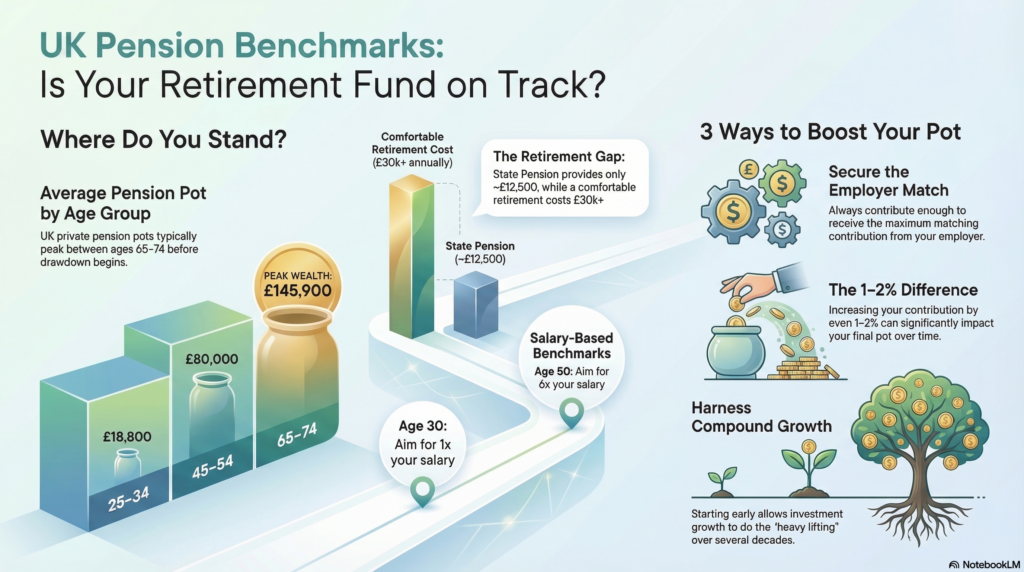
Many people worry about whether they are saving enough for retirement. One common question is:
“How does my pension compare with the average person in the UK?”
The truth is that pension savings vary widely depending on age, income, and career history. However, looking at national statistics can give a useful benchmark for understanding whether you are on track.
Average Pension Pot in the UK by Age
According to data from the Wealth and Assets Survey published by the Office for National Statistics (ONS) [Link], pension wealth generally increases as people progress through their careers and peaks around retirement age.
Here is the average private pension wealth in the UK by age group:
| Age Group | Average Pension Pot |
| 16–24 | £5,500 |
| 25–34 | £18,800 |
| 35–44 | £39,500 |
| 45–54 | £80,000 |
| 55–64 | £137,800 |
| 65–74 | £145,900 |
| 75+ | £59,700 |
The pension pot typically peaks between ages 65 and 74, when most people retire and begin drawing down their savings. After that, the average decreases as pension income is gradually spent.
What Does the Average Pension Actually Mean?
While these numbers provide a useful benchmark, they do not necessarily represent what you need for retirement.
For example:
- The full UK State Pension is roughly £12,500 per year if you have 35 years of National Insurance contributions.
- Financial experts estimate that a basic retirement lifestyle costs around £13,000–£14,000 per year, while a comfortable retirement may require £30,000 or more annually.
This means many people will need additional private pension savings beyond the State Pension.
Why Pension Savings Grow Slowly at First
Many younger workers worry when they see that people under 35 often have less than £20,000 saved in pensions.
However, this is normal.
Pension savings usually grow slowly at first because:
- early career salaries are lower
- contributions start small
- compound growth takes time
But over decades, investment growth and regular contributions can dramatically increase the pension pot.
The Impact of Auto-Enrolment
One reason pension savings are improving in the UK is the introduction of automatic workplace pension enrolment in 2012.
This policy requires employers to automatically enrol eligible employees into pension schemes, with contributions from:
- the employee
- the employer
- tax relief from the government
As a result, millions of workers who previously did not save for retirement are now building pension wealth.
The Gender Pension Gap
Pension statistics also reveal a significant gender gap.
Men typically have larger pension pots than women because women are more likely to:
- take career breaks
- work part-time
- earn lower average salaries
Reducing this gap is a growing policy focus in the UK pension system.
How Much Pension Should You Aim For?
Financial planners often suggest rough benchmarks such as:
- By age 30: pension savings equal to 1× annual salary
- By age 40: about 3× salary
- By age 50: around 6× salary
These rules are only general guidelines, but they help people track progress toward retirement.
Why Many People Still Under-Save for Retirement
Despite improvements, retirement savings remain a major challenge in the UK.
Some common reasons include:
- rising living costs
- housing affordability
- student debt
- lack of financial education
In addition, people are living longer, which means pensions must last for 20–30 years after retirement.
How to Improve Your Pension Savings
Even small changes today can significantly improve your retirement finances.
Here are a few practical steps:
Increase Pension Contributions
Even raising contributions by 1–2% of salary can make a big difference over time.
Take Advantage of Employer Matching
Many employers match pension contributions. Always contribute enough to receive the full employer match.
Start Early
The earlier you start saving, the more powerful compound investment growth becomes.
Use Tax-Efficient Savings
Alongside pensions, many people also build wealth using Individual Savings Accounts (ISAs) to create additional retirement income.
The Bottom Line
The average pension pot in the UK rises steadily with age, reaching around £145,900 for people aged 65–74.
However, averages can be misleading. Some people have far less, while others have significantly more.
The most important factors for building a strong retirement fund are:
- starting early
- contributing consistently
- investing for the long term
- taking advantage of tax-efficient accounts
Even small contributions today can grow into a substantial retirement fund over time.
Sources
- Office for National Statistics – Wealth and Assets Survey
- UK Government State Pension Statistics
- Pension industry research and financial planning guidelines
Why Trust Bright Savings UK?
Bright Savings UK is run by a former banker with over 25 years of experience in the banking and financial services industry. Our goal is to help everyday people save smarter, with clear explanations and practical guidance.
Suggested Internal Links
- What is the Average ISA Savings in the UK by Age? (2026 Guide) [Link]
- What Is the Average Savings Amount in the UK by Age? (2026) [Link]
- How Many ISA Millionaires Are There in the UK? (2026 Guide) [Link]
How We Monetize This Site
To support the research and running of Bright Savings UK, we use two primary methods of monetization:
Display Advertising: We host third-party advertisements through Google AdSense. We do not directly control the specific products shown in these ad units, and their presence does not constitute an endorsement by Bright Savings UK.
Affiliate Links: Some links on this site are affiliate links. If you click and open an account, we may receive a commission. This does not change the price or terms you receive from the provider.
Disclaimer: This article is for educational purposes only and does not constitute financial advice. Always review provider terms directly before applying.