
How to Allocate Your £20000 ISA Allowance in 2026 (By Age Group)
Transparency Disclosure: To keep our guides free for everyone, this post contains affiliate links and display advertisements. If you click an affiliate link and sign up, we may earn a commission at no extra cost to you. As an ex-banker with 25 years of experience, I only recommend tools that I believe provide genuine value to your financial health. Read our full Affiliate Disclosure here.
Every UK adult gets a £20,000 ISA allowance each tax year—one of the most powerful tools for building tax-free wealth.
But the key question is:
👉 How should you split it between Cash ISA, Stocks & Shares ISA, IFISA, and Lifetime ISA?
The answer depends heavily on your age, goals, and risk tolerance.
In this guide, we break down a smart ISA allocation strategy by age group, helping you maximise growth while managing risk.
🧠 First: Understand the 4 Types of ISA
1. Cash ISA
- Low risk
- Ideal for emergency funds
- Returns: ~3%–5%
2. Stocks & Shares ISA
- Invests in markets
- Higher long-term returns (~5%–8%+)
- Value can go up and down
3. Innovative Finance ISA (IFISA)
- Peer-to-peer or property lending
- Higher returns (~5%–12%)
- ⚠️ Capital at risk
4. Lifetime ISA (LISA)
- 25% government bonus
- Max £4,000/year contribution
- Used for:
- First home
- Retirement (age 60+)
Navigating the 2027 Cliff
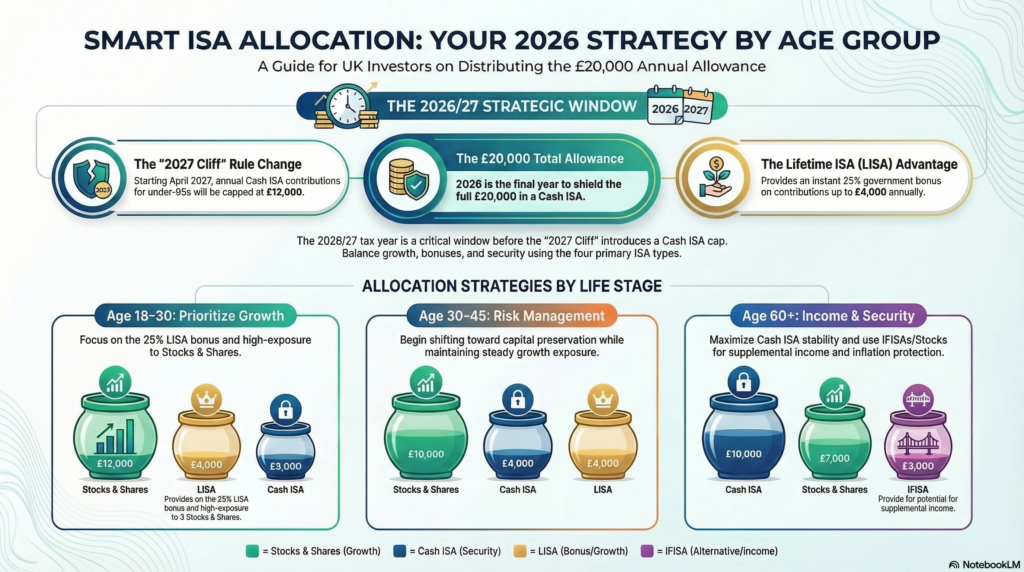
In the 2026/27 tax year, UK investors are at a crossroads. While the standard £20,000 allowance remains, the “Last Great Year for Cash” is upon us. This guide provides a technical and strategic framework for distributing your allowance across the four primary ISA pillars, accounting for your age, risk capacity, and the upcoming legislative changes that will restrict cash savings for those under 65 starting in April 2027.
The “2027 Cliff”: Why 2026 is Your Most Important Tax Year
The Chancellor’s confirmed reforms for April 2027 represent a fundamental shift in UK savings policy.
- The Rule: For anyone under the age of 65 on 6 April 2027, the annual Cash ISA contribution will be capped at £12,000.
- The Strategy: The 2026/27 tax year is the final window to shield a full £20,000 in a pure Cash ISA. For investors who prioritize liquidity and capital guarantee, maximizing this window is a priority before the “forced investment” rules kick in.
- The Goal: The government aims to push £8bn annually from “lazy cash” into UK equities to stimulate the economy. As a strategic investor, you must decide if you will follow that push or lock in cash safety now.
👶 Age 18–30: Growth First
🎯 Focus:
- Long-term growth
- First home (LISA bonus)
Suggested Allocation:
| ISA Type | Allocation |
| LISA | £4,000 |
| Stocks & Shares ISA | £12,000 |
| Cash ISA | £3,000 |
| IFISA | £1,000 |
Why:
- You have time to ride market volatility
- LISA gives instant 25% return (hard to beat)
- Small IFISA exposure for higher yield
👉 Priority = growth + bonus
👨💼 Age 30–45: Balance Growth & Stability
🎯 Focus:
- Wealth building
- Family responsibilities
- Medium-term goals
Suggested Allocation:
| ISA Type | Allocation |
| LISA | £4,000 (if eligible) |
| Stocks & Shares ISA | £10,000 |
| Cash ISA | £4,000 |
| IFISA | £2,000 |
Why:
- Still strong growth focus
- More cash buffer needed
- Slightly increased IFISA exposure (if risk tolerance allows)
👉 Priority = balanced growth
The ISA “Invisible Tax” Calculator
See how inflation eats your £20,000 allowance if your interest rate doesn’t keep up with the cost of living.
Average Cash ISA (2026)
UK Target is 2.0%
Your Wealth is Growing
In 10 years, your purchasing power will change.
Final Cash Value
£0
The number on your screen
Real Value (Adjusted)
£0
Actual purchasing power
Inflation Loss
£0
Lost to rising costs
🏦 Banker’s Insight
Most savers only look at the “Final Cash Value.” But if your inflation rate is higher than your interest rate, you are effectively paying an Invisible Tax. To protect your £20k allowance, your total yield must exceed CPI. This is why many 2026 investors are moving a portion of their ISA into Stocks or IFISAs to bridge the gap.
👨👩👧 Age 45–60: Protect & Grow
🎯 Focus:
- Capital preservation
- Retirement planning
Suggested Allocation:
| ISA Type | Allocation |
| Stocks & Shares ISA | £8,000 |
| Cash ISA | £7,000 |
| IFISA | £2,000 |
| LISA | £3,000 (if still contributing) |
Why:
- Reduce risk gradually
- Increase stable cash holdings
- Maintain some growth exposure
👉 Priority = risk management + steady growth
👴 Age 60+: Income & Capital Protection
🎯 Focus:
- Income generation
- Capital preservation
Suggested Allocation:
| ISA Type | Allocation |
| Cash ISA | £10,000 |
| Stocks & Shares ISA | £7,000 |
| IFISA | £3,000 |
| LISA | £0 |
Why:
- Cash provides stability and liquidity
- Stocks still needed for inflation protection
- IFISA for income (only if risk understood)
👉 Priority = income + security
⚠️ Where IFISA Fits (Important)
The Innovative Finance ISA should always be:
- A small portion of your portfolio
- Used only if you understand:
- Default risk
- Liquidity risk
- Platform risk
👉 A good rule:
Limit IFISA to 5%–15% of your ISA allocation
📊 Key Principles Behind These Allocations
1. Age = Risk Capacity
- Younger = more risk
- Older = more stability
2. Time Horizon Matters
- Longer time = more stocks
- Shorter time = more cash
3. Diversification Is Critical
Don’t rely on a single ISA type.
4. Use Your Full Allowance
Many people waste their £20,000 allowance each year.
👉 Once lost, it’s gone forever.
🛡️ The Banker’s Reality Check
Even within ISAs:
- Stocks can fall sharply
- IFISA capital can be lost
- Cash may lose value to inflation
A smart allocation balances:
👉 Growth, income, and protection
✅ Bright Savings UK Verdict
There is no “perfect” ISA split—only the one that fits your stage of life.
But a clear pattern emerges:
- Younger investors should maximise growth and bonuses
- Mid-life investors should balance growth with stability
- Older investors should protect capital and generate income
💡 Bright Savings UK Tip:
Don’t overcomplicate your ISA strategy. A simple mix of Stocks & Shares + Cash ISA + small IFISA exposure is enough for most people.
Why Trust Bright Savings UK?
Bright Savings UK is run by a former banker with over 25 years of experience in the banking and financial services industry. Our goal is to help everyday people save smarter, with clear explanations and practical guidance.
Suggested Internal Links
- Innovative Finance ISA (IFISA): High Returns or High Risk? A 2026 UK Guide [Link]
- Trading 212 vs XTB: The Battle for the 2026 UK ISA Crown [Link]
- Inflation, Interest Rates, and Your Savings: What UK Savers Need to Know (2026) (2026 Guide) [Link]
How We Monetize This Site
To support the research and running of Bright Savings UK, we use two primary methods of monetization:
- Affiliate Links: Some links on this site are affiliate links. If you click and open an account, we may receive a commission. This does not change the price or terms you receive from the provider.
- Display Advertising: We host third-party advertisements through Google AdSense. We do not directly control the specific products shown in these ad units, and their presence does not constitute an endorsement by Bright Savings UK.
Disclaimer: This article is for educational purposes only and does not constitute financial advice. Always review provider terms directly before applying.