
How to Receive Money from Overseas in the UK (Without Losing Fees) – 2026 Guide
Transparency Disclosure: To keep our guides free for everyone, this post contains affiliate links and display advertisements. If you click an affiliate link and sign up, we may earn a commission at no extra cost to you. As an ex-banker with 25 years of experience, I only recommend tools that I believe provide genuine value to your financial health. Read our full Affiliate Disclosure here.
If you’re an international student or newcomer living in the UK, you may need to receive money from overseas for:
- Tuition fees
- Rent and living expenses
- Family support
- Savings transfers
- Salary from abroad
But here’s the problem:
Traditional bank transfers can quietly eat into your money through hidden exchange rate markups and fees.
So how can you receive money in the UK safely, quickly, and without losing unnecessary fees?
This guide explains your best options in 2026.
Understand How Overseas Transfers Really Work
When someone sends you money from another country, two main costs usually apply:
1️⃣ Transfer Fee
A fixed charge to send the money.
2️⃣ Exchange Rate Markup
This is the hidden one.
Many banks don’t use the real market exchange rate. Instead, they:
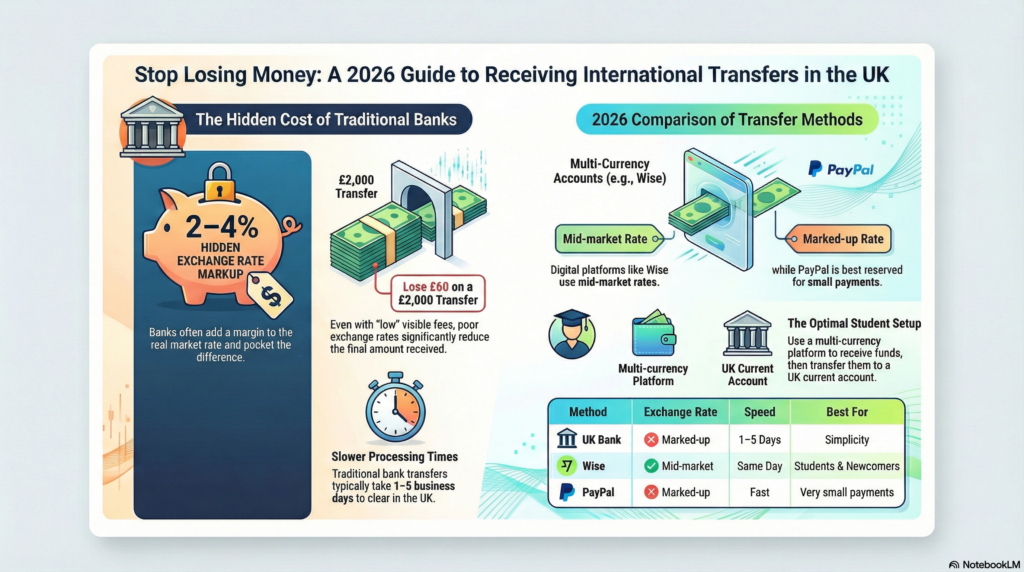
- Add 2–4% margin to the rate
- Keep the difference as profit
This can cost far more than the visible fee.
Option 1: Receiving Money via a UK Bank Account
Most students first think:
“I’ll just give my UK bank details.”
This works — but may not be the cheapest option.
Pros:
✔ Simple
✔ Direct into your UK current account
✔ Regulated and secure
Cons:
❌ Often poor exchange rates
❌ Possible receiving fees
❌ Slower (1–5 business days)
For large transfers, even a 3% markup can mean losing £60 on a £2,000 transfer.
Option 2: Using a Multi-Currency Account (Often Cheaper)
Many newcomers now use platforms like Wise to receive overseas payments.
Here’s why:
✔ Real Mid-Market Exchange Rate
The same rate you see on Google — no hidden markup.
✔ Transparent Fees
You see exactly what you’ll receive.
✔ Multi-Currency Accounts
You can:
- Receive USD, EUR, SGD, AUD, etc.
- Hold the money in foreign currency
- Convert when rates are favourable
✔ Faster Transfers
Often same-day or within hours.
For students receiving money regularly, this can save hundreds per year.
Option 3: Revolut or Other Digital Banks
Some digital banks allow foreign transfers and currency holding.
Pros:
✔ Competitive rates
✔ App-based
✔ Easy to manage
Cons:
❌ Free plans may have limits
❌ Exchange markups outside trading hours
These can be good alternatives depending on your needs.
Option 4: PayPal (Usually Expensive)
While convenient, PayPal is rarely ideal for receiving international funds into a UK bank account.
Why?
- High currency conversion fees
- Exchange rate markups
- Extra withdrawal charges
It’s better for small payments — not tuition or rent.
Quick Comparison: Best Ways to Receive Overseas Money
| Method | Exchange Rate | Fees | Speed | Best For |
| UK Bank | Marked-up | Medium–High | 1–5 days | Simplicity |
| Wise [Link] | Mid-market | Low | Same day | Students & newcomers |
| Revolut | Competitive | Low–Medium | Fast | Multi-currency users |
| PayPal | Marked-up | High | Fast | Small payments |
Example: Receiving £1,500 from Abroad
Traditional Bank
- 3% exchange markup = £45 lost
- Possible receiving fee = £5–£15
You might receive around £1,440.
Wise [Link]
- Transparent fee (much lower)
- Mid-market rate
You may receive closer to £1,485–£1,495.
Over a year, this difference adds up.
Is It Safe to Use Digital Transfer Platforms?
Yes — as long as they are regulated.
Wise and similar providers are regulated financial institutions. Funds are safeguarded separately from company operating money.
Always:
✔ Verify the sender details
✔ Double-check your account information
✔ Avoid unknown third-party agents
Best Setup for International Students
The most practical approach:
1️⃣ Open a UK current account (for daily spending)
2️⃣ Use a multi-currency platform for receiving international funds
3️⃣ Transfer into your UK bank when needed
This gives:
- Lower costs
- Better exchange rates
- Full local banking functionality
When a Traditional Bank Is Fine
You may not need alternatives if:
- You receive money only once per year
- The amount is small
- Your home bank offers good exchange rates
But for regular transfers, comparing options is usually worth it.
Final Advice: Always Compare Before Accepting the Rate
Before confirming any transfer:
✔ Check the mid-market rate
✔ Compare total fees
✔ Look at the final amount you’ll receive
The cheapest option isn’t always obvious from the headline fee.
Final Thoughts
Receiving money from overseas in the UK doesn’t have to be expensive — but it often is if you don’t check the details.
For many international students and newcomers, using a multi-currency platform alongside a UK bank account offers the best balance of:
- Cost efficiency
- Transparency
- Speed
- Flexibility
Taking 5 minutes to compare rates could save you more than you expect.
Why Trust Bright Savings UK?
Bright Savings UK is run by a former banker with over 25 years of experience in the banking and financial services industry. Our goal is to help everyday people save smarter, with clear explanations and practical guidance.
Suggested Internal Links
- Is Wise Worth It for International Students in the UK? (2026 Review) [Link]
- Wise vs Traditional Bank Transfer UK (2026) [Link]
- How International Students and New Immigrants Can Open a UK Bank Account Without a Utility Bill (2026) [Link]
How We Monetize This Site
To support the research and running of Bright Savings UK, we use two primary methods of monetization:
Display Advertising: We host third-party advertisements through Google AdSense. We do not directly control the specific products shown in these ad units, and their presence does not constitute an endorsement by Bright Savings UK.
Affiliate Links: Some links on this site are affiliate links. If you click and open an account, we may receive a commission. This does not change the price or terms you receive from the provider.
Disclaimer: This article is for educational purposes only and does not constitute financial advice.