
Is There £2,000 Waiting for You? How to Claim Your UK Child Trust Fund in 2026
Transparency Disclosure: To keep our guides free for everyone, this post contains affiliate links and display advertisements. If you click an affiliate link and sign up, we may earn a commission at no extra cost to you. As an ex-banker with 25 years of experience, I only recommend tools that I believe provide genuine value to your financial health. Read our full Affiliate Disclosure here.
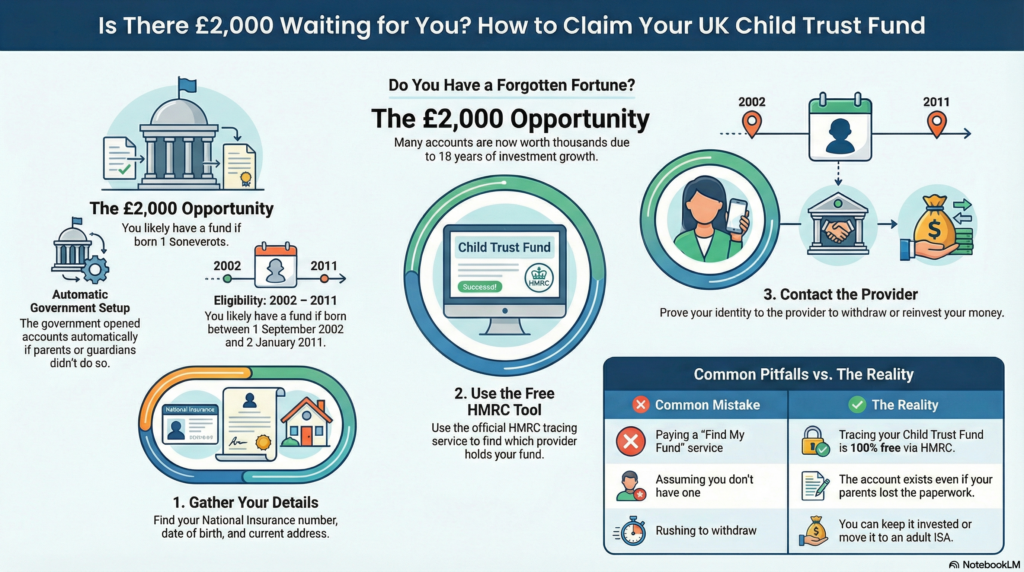
If you were born in the UK in the early 2000s, there’s a real chance you have money saved in a Child Trust Fund — and you might not even know it.
For many people, this forgotten account can be worth hundreds or even thousands of pounds by the time they reach adulthood.
This guide explains what a Child Trust Fund is, who might have one, and how to find and claim it in 2026.
What Is a Child Trust Fund?
A Child Trust Fund (CTF) [Link] is a long-term savings account set up by the UK government for children born between:
- 1 September 2002 and 2 January 2011
If you were born during this period, the government:
- Automatically opened an account if your parents didn’t
- Paid in an initial voucher (usually £250)
- Allowed family and friends to add money over time
The money was locked away until age 18.
Why Some Child Trust Funds Are Worth £2,000 (or More)
The final value depends on:
- Whether extra contributions were made
- How long the money was invested
- Whether it was a cash or investment CTF
Some accounts:
- Were invested in stock-market funds
- Benefited from long-term growth
- Have had 18+ years to build up
That’s why balances can range from a few hundred pounds to several thousand.
Who Might Have a Child Trust Fund?
You may have a CTF if:
- You were born between 2002 and 2011
- Your parents or guardians received child benefit
- You grew up in the UK
Even if your parents don’t remember opening one, the government may have done it automatically.
What Happens at Age 18?
When you turn 18:
- The Child Trust Fund becomes yours
- You gain full control of the money
- The account usually converts into an adult ISA
But here’s the key problem 👇
Many people are never told where their account is held.
How to Find Your Child Trust Fund (Step by Step)
If you don’t know where your CTF is, don’t worry — there’s an official way to trace it.
Step 1: Gather Basic Information
You’ll need:
- Your full name
- Date of birth
- National Insurance number (if available)
- Current address
Step 2: Use the Official Government Tracing Service
You can use the free Child Trust Fund tracing service provided by HM Revenue & Customs.
They can tell you:
- Whether you have a CTF
- Which provider holds it
This service does not tell you the balance — only where it is.
Step 3: Contact the Provider
Once you know the provider:
- Contact them directly
- Prove your identity
- Ask how to access or transfer the funds
You may be able to:
- Withdraw the money
- Transfer it into an adult ISA
- Leave it invested
What If Your Parents Managed the Account?
In some cases:
- Parents may still have paperwork
- The account may already be converted
- The provider may have changed names
Even if records are lost, the account itself does not disappear.
Common Mistakes to Avoid
❌ Paying third-party “find my fund” services
❌ Assuming you don’t have one because you don’t remember
❌ Ignoring letters from unknown financial providers
❌ Rushing to withdraw without understanding options
Tracing your CTF is free — you never need to pay.
What Should You Do With the Money?
Once you find it, think carefully.
Options include:
- Keeping it invested
- Moving it into a Cash ISA
- Using it for education or emergencies
- Starting a long-term savings habit
This could be your first real financial asset.
Final Thought
Many young adults in the UK are sitting on money they didn’t even know existed.
If you were born between 2002 and 2011, it’s worth taking 10 minutes to check.
That forgotten Child Trust Fund could give you a valuable financial head start.
Why Trust Bright Savings UK?
Bright Savings UK is run by a former banker with over 25 years of experience in the banking and financial services industry. Our goal is to help everyday people save smarter, with clear explanations and practical guidance.
Suggested Internal Links
- Junior ISA vs Children’s Savings Accounts [Link]
- What Is the Average Savings Amount in the UK by Age? (2026) [Link]
- Why Starting to Save Early Matters [Link]
How We Monetize This Site
To support the research and running of Bright Savings UK, we use two primary methods of monetization:
- Affiliate Links: Some links on this site are affiliate links. If you click and open an account, we may receive a commission. This does not change the price or terms you receive from the provider.
- Display Advertising: We host third-party advertisements through Google AdSense. We do not directly control the specific products shown in these ad units, and their presence does not constitute an endorsement by Bright Savings UK.
Disclaimer: This article is for educational purposes only and does not constitute financial advice. Always review provider terms directly before applying.