
What Is the Average Savings Amount in the UK by Age? (2026)
Transparency Disclosure: To keep our guides free for everyone, this post contains affiliate links and display advertisements. If you click an affiliate link and sign up, we may earn a commission at no extra cost to you. As an ex-banker with 25 years of experience, I only recommend tools that I believe provide genuine value to your financial health. Read our full Affiliate Disclosure here.
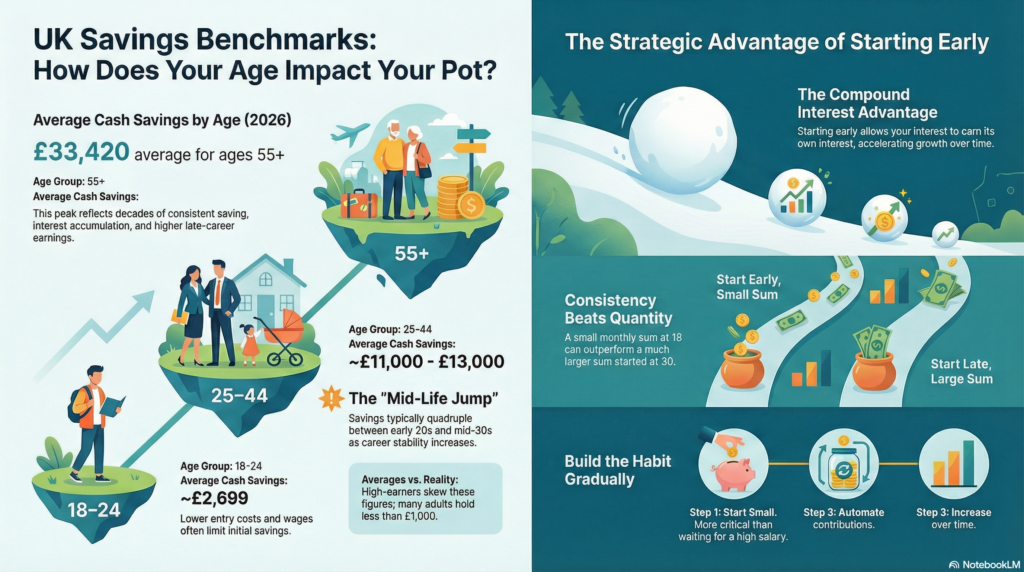
Everyone’s savings journey is different — but looking at the numbers can help you understand how typical savings vary as people get older in the UK. These figures also show why starting to save sooner rather than later is such a powerful financial advantage.
📊 Average Savings in the UK by Age (2026)
According to a 2026 survey of UK adults, average savings amounts differ widely by age group:
| 👉 18-24 year olds: | ~£2,699 |
| 👉 25-34 year olds: | ~£11,023 |
| 👉 35-44 year olds: | ~£13,379 |
| 👉 45-54 year olds: | ~£12,452 |
| 👉 55 and over: | ~£33,420 |
These figures are based on cash savings — the money people hold in savings accounts rather than investments or pension pots. This table shows the average amount of cash savings held by people in the UK at different ages. It highlights a clear pattern: savings tend to grow as people get older — largely because they’ve had more time to earn, save, and benefit from interest.
However, it also shows that many young people start with very little savings, which is why starting early — even with small amounts — can make a huge difference over time.
💡 Notice the pattern? Older age groups tend to have more saved — partly because they’ve had more time to earn, save, and avoid spending all their income.
🧠 What These Numbers Really Mean
Here are a few things the data highlights:
🔹 16-24s often have very low savings
At around £2,699 on average, many young adults don’t yet have large cash savings — often due to student costs, part-time jobs, rent, and other new expenses.
🔹 Mid-20s to 40s usually see savings rise
Savings jump significantly in the 25-34 and 35-44 age ranges, as incomes increase and people start planning for things like homes and families.
🔹 It grows further in later life
Those aged 55+ have much higher average savings — often reflecting years of consistent saving and possibly home equity or pension planning.
📈 But Averages Can Be Misleading
It’s important to understand:
These figures are averages — some people have much more, and some have much less.
Many UK adults still have very little saved; a significant number have under £1,000 in savings or none at all.
Averages can be pulled up by a small number of people with very high savings, especially in older groups.
So “average” doesn’t mean “normal” for everyone — but it offers a useful benchmark.
❗ Why Younger People Tend to Save Less
There are several common reasons:
Lower starting salaries
Student loans and rent costs
Less time to build long-term savings
Higher everyday expenses relative to income
Because of this, younger age groups often have smaller safety nets — which makes starting to save early even more important.
🤔 Why Your Age Matters for Savings
🔹 Time is your biggest advantage
If you start saving in your late teens or early 20s, your money has more time to:
Earn interest
Compound — which means interest starts earning interest
Grow into a larger fund over decades
This can make a huge difference compared to starting later. The earlier you start, the smaller each contribution needs to be to reach your goals.
📌 Example: The Power of Time
Imagine two people:
Person A starts saving £50 a month at age 18
Person B starts saving £150 a month at age 30
Even though Person B saves more each month, Person A’s pot may grow to be almost the same or larger by retirement — thanks to compound interest and time. (You can link to your dedicated article explaining how interest works for more depth.)
💡 Real-World Takeaways
✔ Comparing yourself to averages can help you see where you stand — but don’t treat them as goals.
✔ Thousands of young adults have low savings — and that’s normal, not shameful, as long as you start building gradually.
✔ The best time to save is as soon as you can — even small amounts matter because of time and compounding.
🧠 Final Thought
Your savings amount is shaped by your age, income, expenses, and goals — but the habit of saving early is one of the most powerful tools for financial health.
Starting early doesn’t require a big salary — just consistency, awareness, and patience.
Why Trust Bright Savings UK?
Bright Savings UK is run by a former banker with over 25 years of experience in the banking and financial services industry. Our goal is to help everyday people save smarter, with clear explanations and practical guidance.
Suggested Internal Links
Why Starting to Save at 18 Beats Saving More at 30 [Link]
What Is Interest? Simple vs Compound Interest [Link]
How to Build an Emergency Fund in the UK (UK Beginner Guide) [Link]
Sources:
Finder UK Savings Statistics (2026) [Link]
Forbes Advisor UK [Link]
Important
Important: These figures are averages. Many people have more, and many have less. They are meant to provide context — not targets or expectations.
How We Monetize This Site
To support the research and running of Bright Savings UK, we use two primary methods of monetization:
- Affiliate Links: Some links on this site are affiliate links. If you click and open an account, we may receive a commission. This does not change the price or terms you receive from the provider.
- Display Advertising: We host third-party advertisements through Google AdSense. We do not directly control the specific products shown in these ad units, and their presence does not constitute an endorsement by Bright Savings UK.
Disclaimer: This article is for educational purposes only and does not constitute financial advice. Always review provider terms directly before applying.