
💸 The £1,000 Trap: Why Saving Feels Harder Than Ever and the 2026 Strategy to Finally Break Free
Transparency Disclosure: To keep our guides free for everyone, this post contains affiliate links and display advertisements. If you click an affiliate link and sign up, we may earn a commission at no extra cost to you. As an ex-banker with 25 years of experience, I only recommend tools that I believe provide genuine value to your financial health. Read our full Affiliate Disclosure here.
Struggling to save your first £1,000? You’re not alone. Discover why the “£1,000 Trap” is harder to escape in the UK today—and the simple, friction-based strategy to break the cycle for good.
🚨 The Hardest £1,000 You’ll Ever Save
Ask anyone who has built wealth, and they’ll tell you the same thing:
“The first £1,000 is the hardest.”
In 2026, that’s more than just a cliché—it’s a financial reality. It’s not just about your willpower anymore; it’s about a system designed to keep your balance at zero.
Welcome to The £1,000 Trap.
🧠 What Is the £1,000 Trap?
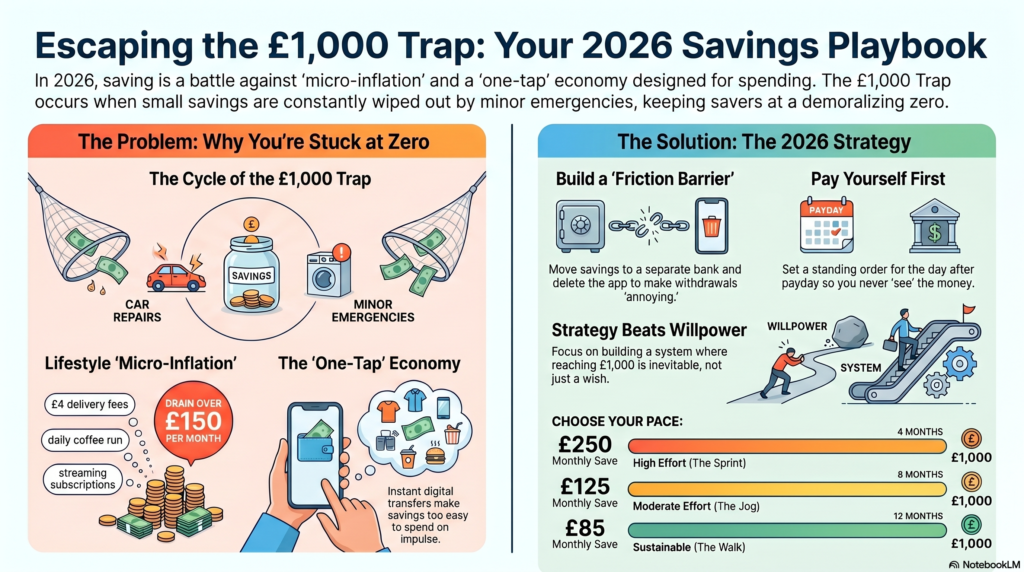
The £1,000 Trap is a demoralizing cycle that looks like this:
- The Effort: You cut back and manage to save £300.
- The Event: The car needs a tire, or the dental bill arrives.
- The Reset: You dip into the savings to cover it.
- The Result: You’re back at zero, feeling like saving is “impossible.”
📉 Why Saving Feels Harder Today
It isn’t in your head. The UK economy in 2026 has created unique hurdles:
- Invisible Margin Erosion: Rent, energy, and food have crept up just enough to swallow your “leftover” cash.
- Lifestyle “Micro-Inflation”: You aren’t buying Ferraris, but £8 streaming subs and £4 delivery fees add up to a “leak” of £150+ a month.
- The “One-Tap” Economy: Banking is now too easy. Instant transfers mean your savings are always just two clicks away from being spent.
- Psychological Fatigue: When the finish line keeps moving, “Reward Spending” (I deserve this coffee or takeaway) becomes a coping mechanism for financial stress.
🔓 How to Break the Trap (The 2026 Playbook)
1. The “Friction Barrier” Strategy
If your savings are in the same app as your spending money, they aren’t savings—they’re just “delayed spending.”
- The Fix: Open a savings account with a completely different bank. Do not install the app on your home screen. Make it “annoying” to get the money out.
2. Lower the Target to Build Momentum
Don’t stare at the £1,000 mountain. It’s too high.
- The Fix: Aim for £100. Then £250. Every time you hit a mini-goal, your brain gets a hit of dopamine that fuels the next stage.
3. Flip the Script: Save First
Most people save “what is left” at the end of the month. In 2026, there is never anything left.
- The Fix: Treat your savings like a bill. Set up a Standing Order for the day after payday. If you don’t see it, you won’t miss it.
4. The “One-In, One-Out” Rule
You don’t need a restrictive “no-fun” budget.
- The Fix: Cut one recurring expense (that subscription you don’t watch) and redirect it. That £12/month is £144 a year toward your goal without you feeling the pinch.
📊 The Path to £1,000: Choose Your Speed
| Monthly Save | Time to £1,000 | Effort Level |
| £250 | 4 Months | High (The Sprint) |
| £125 | 8 Months | Moderate (The Jog) |
| £85 | 12 Months | Sustainable (The Walk) |
🧠 The Mindset Shift
Stop saying: “I need to save £1,000.”
Start saying: “I am building a system where £1,000 is inevitable.”
Once you hit that first grand, the “Trap” breaks. You finally have a buffer that absorbs life’s shocks, allowing your next thousand to grow undisturbed.
🔍 Final Thought
The £1,000 Trap isn’t a reflection of your character; it’s a reflection of your current strategy. In an economy designed to make you spend, strategy beats willpower every time.
✅ Key Takeaway: The first £1,000 isn’t just money—it’s your “Get Out of Jail Free” card. Buy your freedom one pound at a time.
Why Trust Bright Savings UK?
Bright Savings UK is run by a former banker with over 25 years of experience in the banking and financial services industry. Our goal is to help everyday people save smarter, with clear explanations and practical guidance.
Suggested Internal Links
- Why Most Students and the Young Are Broke: 5 Money Habits to Change Today [Link]
- The Banker’s Strategy for Daily Expenses: Why JamDoughnut is My Go-To Shopping Companion in 2026 [Link]
- The “Hidden Gem” Savings Accounts Paying 7% in the UK (April 2026) [Link]
How We Monetize This Site
To support the research and running of Bright Savings UK, we use two primary methods of monetization:
- Affiliate Links: Some links on this site are affiliate links. If you click and open an account, we may receive a commission. This does not change the price or terms you receive from the provider.
- Display Advertising: We host third-party advertisements through Google AdSense. We do not directly control the specific products shown in these ad units, and their presence does not constitute an endorsement by Bright Savings UK.
`Disclaimer: This article is for educational purposes only and does not constitute financial advice. Always review provider terms directly before applying.