
Money Market Funds vs. Cash ISAs: Preparing for the 2027/28 Tax Rule Changes
Transparency Disclosure: To keep our guides free for everyone, this post contains affiliate links and display advertisements. If you click an affiliate link and sign up, we may earn a commission at no extra cost to you. As an ex-banker with 25 years of experience, I only recommend tools that I believe provide genuine value to your financial health. Read our full Affiliate Disclosure here.
With interest rates having fluctuated wildly over the last few years, UK savers are paying more attention than ever to where they park their cash. For a long time, the humble bank account was enough. Now, sophisticated savers are constantly weighing up their options to maximize yield while minimizing their tax burden.
Two of the biggest heavyweights in the cash-parking arena are Cash ISAs and Money Market Funds (MMFs). But with a shifting regulatory landscape on the horizon, how do you choose between them? Let’s break down the mechanics, the risks, and the crucial tax implications you need to prepare for.
What is a Cash ISA?
A Cash Individual Savings Account (ISA) is essentially a tax-free wrapper for your savings. Every UK adult gets an annual ISA allowance (currently £20,000), and any interest earned on cash held within this wrapper is completely shielded from Income Tax.
The Pros:
- Absolute Tax Shelter: You pay zero tax on the interest, regardless of your income tax band.
- FSCS Protection: Funds held in UK-regulated banks and building societies are protected up to £85,000 per institution.
- Simplicity: They function exactly like standard savings accounts.
The Cons:
- Rate Lags: High-street banks can sometimes be slow to pass on Bank of England base rate increases to ISA customers.
- Strict Limits: You cannot deposit more than your £20k annual allowance across all your ISAs.
What is a Money Market Fund (MMF)?
A Money Market Fund is a type of mutual fund that invests in highly liquid, short-term debt instruments—think government bonds (gilts) and short-term corporate debt. They are designed to offer a yield closely aligned with the Bank of England base rate while maintaining capital stability.
The Pros:
- Agility: MMF yields react almost immediately to central bank rate changes.
- No Upper Deposit Limit: Unlike an ISA, you can invest as much as you want.
- Diversification: Your money is spread across various institutional-grade instruments.
The Cons:
- Not Technically Cash: Because it is an investment, capital is at risk (though MMFs are considered very low risk).
- Platform Fees: You often have to buy MMFs through an investment broker, which may charge platform or dealing fees that eat into your yield.
- Taxable Income: Unless held within a Stocks & Shares ISA, the yield generated is subject to standard tax rules.
The Core Debate: The 2027/28 Tax Rule Changes
Historically, higher-rate and additional-rate taxpayers have utilized MMFs to chase higher yields when standard savings rates were abysmal. However, the regulatory environment is shifting, and this is where careful planning is required.
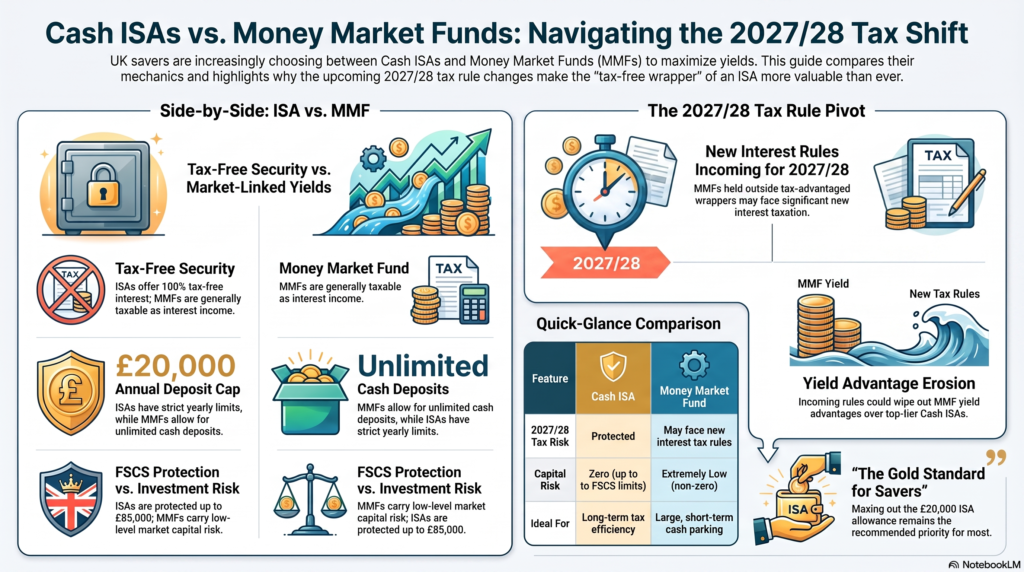
Crucially, Money Market Funds may not be exempted from the new interest rules expected to take effect in the 2027/28 tax year.
While the Personal Savings Allowance (PSA) currently allows basic rate taxpayers to earn £1,000 in interest tax-free (and £500 for higher rate taxpayers), the incoming adjustments to interest taxation mean that holding MMFs outside of a tax-advantaged wrapper could result in a surprisingly hefty tax bill. Because an MMF’s yield is generally treated as interest rather than dividend income for tax purposes, falling foul of the upcoming 2027/28 changes could quickly wipe out the slight yield advantage an MMF might hold over a top-tier Cash ISA.
Side-by-Side Comparison
| Feature | Cash ISA | Money Market Fund |
| Tax Status | 100% Tax-Free | Taxable (unless in a wrapper) |
| 2027/28 Tax Risk | Protected | May face new interest tax rules |
| Capital Risk | Zero (up to FSCS limits) | Extremely Low (but non-zero) |
| Deposit Limit | £20,000 annually | Unlimited |
| Ideal For | Long-term tax efficiency | Large, short-term cash parking |
Which Should You Choose?
The decision ultimately comes down to your tax band, the size of your cash pot, and your timeline.
- For the vast majority of savers: Maxing out your £20,000 Cash ISA allowance remains the gold standard. The peace of mind that comes with a permanent tax shelter and FSCS protection is hard to beat.
- For high-net-worth individuals: If you have fully utilized your ISA allowance and need to park a significant sum of cash (for example, proceeds from a house sale) for a short period, an MMF offers a highly liquid, competitive yield. Just be sure to model the tax implications ahead of the 2027/28 changes.
Why Trust Bright Savings UK?
Bright Savings UK is run by a former banker with over 25 years of experience in the banking and financial services industry. Our goal is to help everyday people save smarter, with clear explanations and practical guidance.
Suggested Internal Links
- UK ISA Rule Changes in April 2027: What Different Age Groups Should Do Now [Link]
- IG UK Review: How to Start Trading Shares and Forex in UK [Link]
- 2027 ISA Allowance Changes: How to Protect Your Savings and Invest Smarter [Link]
How We Monetize This Site
To support the research and running of Bright Savings UK, we use two primary methods of monetization:
- Affiliate Links: Some links on this site are affiliate links. If you click and open an account, we may receive a commission. This does not change the price or terms you receive from the provider.
- Display Advertising: We host third-party advertisements through Google AdSense. We do not directly control the specific products shown in these ad units, and their presence does not constitute an endorsement by Bright Savings UK.
Disclaimer: This article is for educational purposes only and does not constitute financial advice. Investing involves risk. Capital is at risk, and you may lose money. Trading CFDs and leveraged products carries risk and may not be suitable for all investors. Always review provider terms directly before applying.