
UK ISA Rule Changes in April 2027: What Different Age Groups Should Do Now
Transparency Disclosure: To keep our guides free for everyone, this post contains affiliate links and display advertisements. If you click an affiliate link and sign up, we may earn a commission at no extra cost to you. As an ex-banker with 25 years of experience, I only recommend tools that I believe provide genuine value to your financial health. Read our full Affiliate Disclosure here.
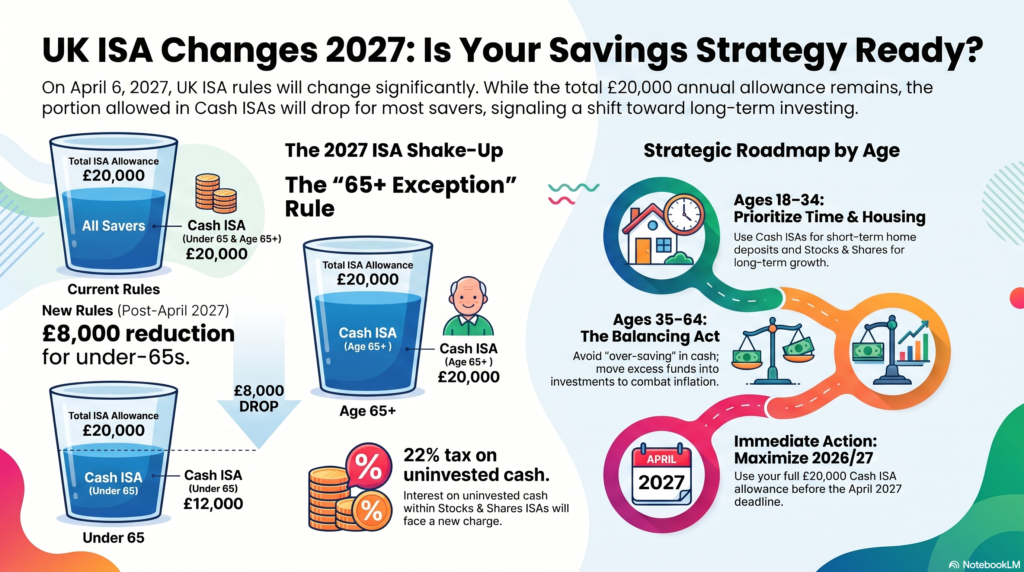
The UK Government has confirmed significant changes to ISA rules from 6 April 2027. While the overall ISA allowance remains at £20,000 per tax year, the amount that people under 65 can place into a Cash ISA will fall from £20,000 to £12,000. The remaining allowance will need to be used in other ISA products such as Stocks & Shares ISAs or Innovative Finance ISAs. [Link]
For many savers, this is one of the biggest ISA changes in years.
The question is not whether the rules are changing—the question is:
“What should I do about it?”
The answer depends on your age, financial goals, and risk tolerance.
What Is Changing in April 2027?
For people under 65
✅ Cash ISA annual limit falls from £20,000 to £12,000
✅ Overall ISA allowance remains £20,000
✅ Up to £8,000 can still be invested in other ISA products
✅ Transfers from Stocks & Shares ISAs back into Cash ISAs will be restricted
✅ Interest earned on uninvested cash inside Stocks & Shares ISAs will be subject to a 22% charge under the new rules.
For people aged 65 and over
✅ Cash ISA allowance remains £20,000
✅ Existing ISA flexibility largely remains unchanged.
Age 18-24: Build Habits, Not Just Savings
If you are a student or young worker, you may think these changes do not affect you because you are not saving £12,000 a year.
However, this age group has the greatest advantage: time.
Suggested Strategy
Emergency Fund
- Save 3-6 months of expenses in a Cash ISA.
Long-Term Growth
- Start investing small amounts monthly in a Stocks & Shares ISA.
Skills Investment
- Continue investing in education and career development.
Example
Imagine investing only £100 per month at age 20.
Over 40 years, the combination of regular contributions and compound growth could potentially produce a much larger result than waiting until age 35 to start.
The biggest mistake young people make is believing they have plenty of time.
The biggest advantage young people have is exactly that: time.
Age 25-34: Focus on Home Ownership and Wealth Building
Many people in this group are:
- Saving for their first home
- Starting families
- Building careers
Suggested Strategy
House Deposit Needed Within 5 Years
- Prioritise Cash ISA savings.
House Purchase More Than 5 Years Away
- Consider a mixture of Cash ISA and Stocks & Shares ISA.
Use Current Rules While You Can
You still have the 2026/27 tax year before the new restrictions begin.
For those with substantial savings, using the full £20,000 Cash ISA allowance before April 2027 could shelter additional money from future taxation.
Age 35-49: Balance Growth and Security
This is often the busiest financial period of life.
You may be managing:
- Mortgages
- Children
- School costs
- Retirement planning
Suggested Strategy
A balanced approach is often appropriate:
- Emergency savings in Cash ISA
- Medium and long-term investments in Stocks & Shares ISA
- Regular pension contributions
Avoid holding excessive cash that loses purchasing power to inflation.
Many people in this age group are surprised to discover they are over-saving in cash and under-investing for retirement.
Age 50-64: Prepare for Retirement
This age group may feel the greatest impact from the new ISA rules.
Many individuals become more cautious as retirement approaches and prefer cash savings.
However, from April 2027, only £12,000 per year can be placed into a Cash ISA if you are under 65.
Suggested Strategy
- Build a retirement income plan.
- Diversify between cash and investments.
- Use the remaining years before April 2027 wisely.
- Review whether all savings genuinely need to remain in cash.
For those approaching retirement, capital preservation is important—but so is maintaining purchasing power.
Age 65 and Above: Take Advantage of the Exception
Good news for retirees.
The Government has confirmed that individuals aged 65 and above will retain the full £20,000 Cash ISA allowance.
Suggested Strategy
- Continue using Cash ISAs if income stability is the priority.
- Compare ISA rates regularly.
- Review inheritance and estate planning.
- Consider whether some funds should still be invested to combat inflation.
Being retired does not automatically mean avoiding investments completely.
Three Actions Everyone Should Take Before April 2027
1. Maximise Existing ISA Allowances
You still have time before the new rules take effect.
Unused ISA allowances are lost forever.
2. Review Your Cash Position
Ask yourself:
“Do I really need all this money sitting in cash?”
Some cash is essential.
Too much cash can reduce long-term wealth.
3. Learn About Investing
The Government’s reforms clearly encourage more long-term investing. Whether you agree or disagree, understanding investing will become increasingly important.
Final Thought
The ISA changes in 2027 are not a disaster.
They are a reminder that financial planning should evolve with changing rules.
A 20-year-old, a 40-year-old, and a 70-year-old should not use exactly the same strategy.
The smartest savers are not those who react at the last minute.
They are the ones who prepare early.
Your age may determine the options available to you, but your financial future will be determined by the decisions you make today.
Why Trust Bright Savings UK?
Bright Savings UK is run by a former banker with over 25 years of experience in the banking and financial services industry. Our goal is to help everyday people save smarter, with clear explanations and practical guidance.
Suggested Internal Links
- What Type of Investor Are You? A UK Guide to Risk Tolerance & Smarter Wealth Building [Link]
- Best Cash ISA, Savings & Fixed Deposit Rates UK – June 2026 [Link]
- Risk vs. Opportunity: How to Manage Both at Every Stage of Life [Link]
How We Monetize This Site
To support the research and running of Bright Savings UK, we use two primary methods of monetization:
- Affiliate Links: Some links on this site are affiliate links. If you click and open an account, we may receive a commission. This does not change the price or terms you receive from the provider.
- Display Advertising: We host third-party advertisements through Google AdSense. We do not directly control the specific products shown in these ad units, and their presence does not constitute an endorsement by Bright Savings UK.
Disclaimer
Disclaimer: This article is for educational purposes only and does not constitute financial advice. Investing involves risk. Capital is at risk, and you may lose money. Trading CFDs and leveraged products carries risk and may not be suitable for all investors. Always review provider terms directly before applying.