
Why Financial Scams Are Getting Smarter – And How to Protect Yourself
Transparency Disclosure: To keep our guides free for everyone, this post contains affiliate links and display advertisements. If you click an affiliate link and sign up, we may earn a commission at no extra cost to you. As an ex-banker with 25 years of experience, I only recommend tools that I believe provide genuine value to your financial health. Read our full Affiliate Disclosure here.
Imagine receiving a phone call from your son. He sounds worried.
“Dad, I’ve lost my phone. I need £2,000 urgently. Please transfer the money now.”
You recognise his voice. You transfer the money. Only later you discover that your son never called. It was an AI-generated voice clone.
This sounds like science fiction, but it is happening today. Financial scams are becoming more sophisticated, more convincing, and more dangerous. Criminals are using artificial intelligence, social media, and psychological tricks to steal billions of pounds every year.
The good news? You don’t need to be a technology expert to protect yourself. You simply need to understand how scammers think.
Why Are Financial Scams Increasing?
In the past, scams were often easy to spot poor grammar, suspicious email addresses, or unknown international phone numbers. Today, criminals are much smarter. They actively leverage:
- Artificial Intelligence (AI) & Voice Cloning
- Deepfake videos and fake websites
- Social media profiling to gather personal details.
- Instant messaging apps (WhatsApp, Telegram)
Scammers no longer just attack computers; they attack human emotions. They prey on fear, excitement, greed, love, and urgency. Unfortunately, these emotions affect all of us—regardless of age or background.
5 Modern Scams to Watch Out For
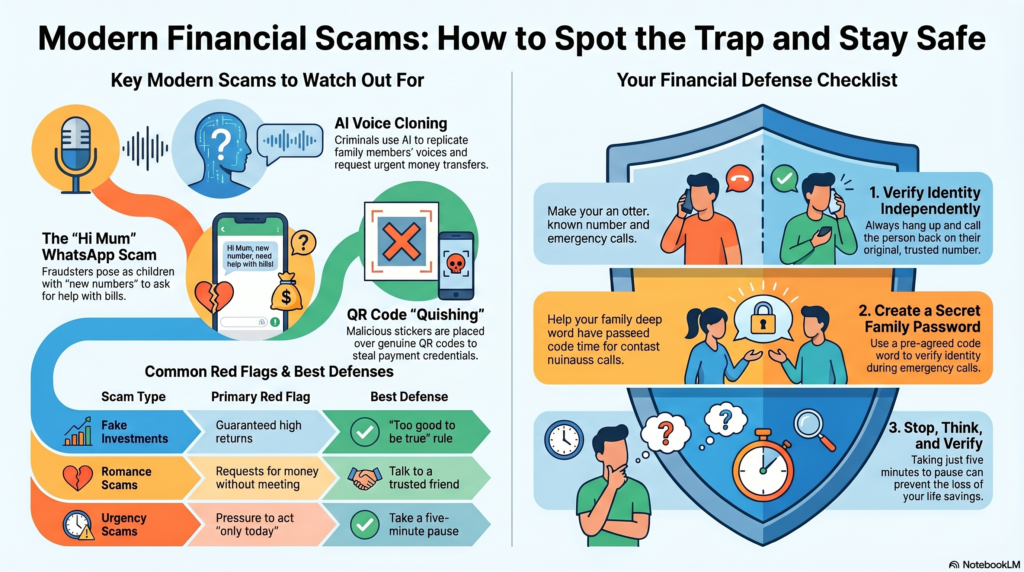
1. AI Voice Cloning
This is one of the fastest-growing scams. Criminals only need a few seconds of audio—often stolen from a video posted on social media—to clone a voice. Using AI, they create a replica that sounds remarkably similar to your family member.
- The Pitch: “I’ve had an accident,” “I’ve been arrested,” or “I’ve lost my phone. Please send money urgently.”
- The Defence:
- Hang up immediately.
- Call the person back using their normal, trusted number.
- Create a secret family password to use in genuine emergencies.
- Never transfer money under psychological pressure.
2. Fake Investment Groups
Have you seen advertisements promising to “Turn £500 into £5,000” or promoting a “VIP WhatsApp trading group with a 95% success rate”? These groups rely on stolen celebrity photos, fake testimonials, and fabricated trading screenshots. At first, you might even see “profits” in a fake online dashboard. But the moment you try to withdraw your funds, the website—and your money—disappears.
- Red Flags: Guaranteed high returns, pressure to invest quickly, “exclusive” secrets, and requests to transfer money overseas or via cryptocurrency.
- The Golden Rule: If something sounds too good to be true, it probably is.
3. The “Hi Mum” WhatsApp Scam
This text-based scam has exploded across the UK.
- The Pitch: You receive a message from an unknown number: “Hi Mum, my phone is broken. This is my new number.” Once they gain your trust, they ask for urgent help to pay a bill or buy a replacement phone.
- The Defence: Never send money immediately. Call your child’s original number first. If they don’t answer, ask the person messaging a security question that only your real child would know. Taking just five minutes to double-check can save you thousands of pounds.
4. QR Code Scams (“Quishing”)
QR codes are everywhere—restaurants, parking meters, train stations, and charity flyers. Scammers have learned to exploit this convenience by placing fake QR code stickers directly over genuine ones.
- The Trap: You think you are paying for your parking space, but the fake code redirects you to a malicious site designed to steal your bank card details, login credentials, and personal information.
- The Defence: Inspect the QR code closely to ensure it isn’t a sticker slapped over an original. When possible, type the website address directly into your browser or use official smartphone apps.
5. Romance Scams
This scam doesn’t target your bank account first; it targets your heart. The scammer spends weeks or even months building trust, sending affectionate messages, and creating deep emotional dependency.
- The Trap: Once you are emotionally invested, the emergencies begin. They suddenly need money for medical expenses, urgent travel costs to come visit you, or a sudden family crisis.
- The Hard Truth: Real love does not require urgent bank transfers. If someone you have never met face-to-face asks for money, stop. Talk to a trusted friend or family member about it and never let embarrassment keep you from speaking up.
Why Smart People Still Get Scammed
Many people believe their profession or education shields them: “I work in finance,” or “I’m too tech-savvy to fall for that.”
Unfortunately, intelligence is not immunity. Scammers are professional manipulators trained in social engineering. They don’t test your IQ; they exploit your blind spots—like your panic when you think a child is hurt, or your loneliness. Even bankers, lawyers, and technology experts fall victim.
The question shouldn’t be, “Am I smart enough?” Instead, ask yourself: “Do I have the right habits to protect myself?”
The Bright Savings UK Prevention Checklist
Before sending money or sharing sensitive personal information, run through these six questions:
- [ ] Am I being pressured to act quickly? (Urgency is a scammer’s biggest weapon).
- [ ] Have I independently verified this person’s identity? (Calling them back on a known number).
- [ ] Is the financial return or offer too good to be true?
- [ ] Is this opportunity allegedly available “only today”?
- [ ] Would I advise a close friend or family member to do this?
- [ ] Have I taken just five minutes to pause and think?
If any answer makes you uneasy: Stop. Think. Verify.
Final Thoughts
Technology will continue to evolve, and so will the tactics of criminals. AI voices and deepfakes will become tougher to spot. However, a solid set of security habits remains your absolute best defence.
Take your time. Verify identities. Question extraordinary claims. It is never embarrassing to be cautious, and it is far better to miss a fleeting “opportunity” than to lose your life savings.
At Bright Savings UK, we believe financial success isn’t just about growing your wealth—it’s about protecting it. Keeping your money safe is how you build a brighter, more secure future.
Why Trust Bright Savings UK?
Bright Savings UK is run by a former banker with over 25 years of experience in the banking and financial services industry. Our goal is to help everyday people save smarter, with clear explanations and practical guidance.
Suggested Internal Links
- What Type of Investor Are You? A UK Guide to Risk Tolerance & Smarter Wealth Building [Link]
- Bright Spending: How to Use Debit and Credit Cards Wisely in the UK (2026) [Link]
- Risk vs. Opportunity: How to Manage Both at Every Stage of Life [Link]
How We Monetize This Site
To support the research and running of Bright Savings UK, we use two primary methods of monetization:
- Affiliate Links: Some links on this site are affiliate links. If you click and open an account, we may receive a commission. This does not change the price or terms you receive from the provider.
- Display Advertising: We host third-party advertisements through Google AdSense. We do not directly control the specific products shown in these ad units, and their presence does not constitute an endorsement by Bright Savings UK.
Disclaimer
Disclaimer: This article is for educational purposes only and does not constitute financial advice. Investing involves risk. Capital is at risk, and you may lose money. Trading CFDs and leveraged products carries risk and may not be suitable for all investors. Always review provider terms directly before applying.