
2027 ISA Allowance Changes: How to Protect Your Savings and Invest Smarter
Transparency Disclosure: To keep our guides free for everyone, this post contains affiliate links and display advertisements. If you click an affiliate link and sign up, we may earn a commission at no extra cost to you. As an ex-banker with 25 years of experience, I only recommend tools that I believe provide genuine value to your financial health. Read our full Affiliate Disclosure here.
The UK savings landscape is facing its biggest shake-up in a generation.
Following confirmation from the Chancellor, major structural reforms are coming to Individual Savings Accounts (ISAs) for the 2027/28 tax year. If you rely primarily on cash savings or hold idle money in investment platforms, these changes will directly impact how your money grows.
At Bright Savings UK, we believe in early preparation over last-minute panic. Here is exactly what is changing from 6 April 2027—and how to build a smarter strategy to insulate your wealth from tax and inflation.
What Is Changing in 2027?
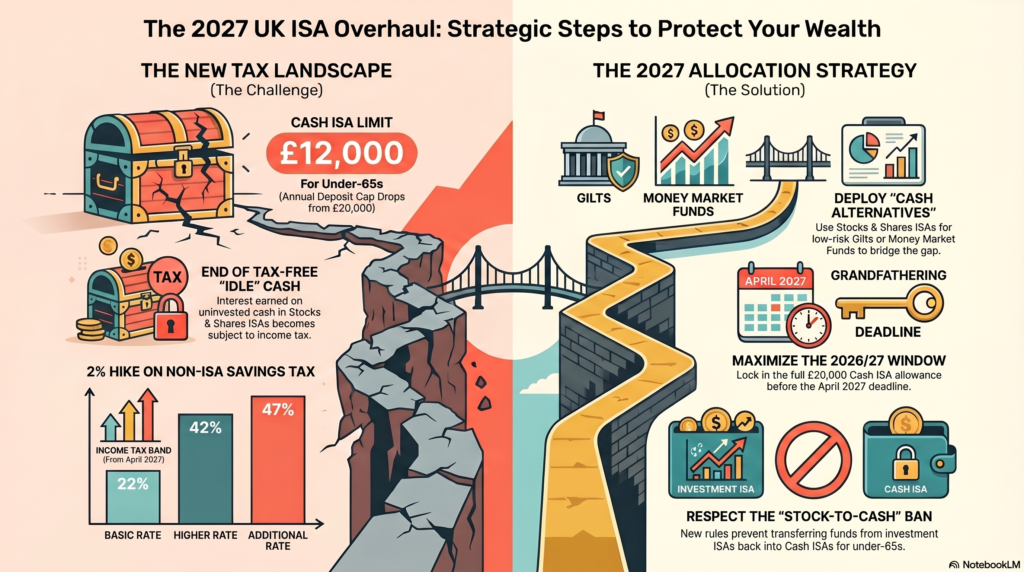
1. The Cash ISA Allowance: Cut to £12,000 (With an Age Split)
Currently, UK adults can shield up to £20,000 per tax year entirely inside a Cash ISA. Under the new rules, the maximum annual Cash ISA contribution is shrinking—but who it affects depends entirely on your age:
- If you are under 65: Your new annual Cash ISA deposit limit will be capped at £12,000. The remaining £8,000 of your overall £20,000 ISA allowance must be directed into other types, such as Stocks & Shares ISAs, Innovative Finance ISAs, or Lifetime ISAs.
- If you are 65 or over: You are exempt from the cap. Your allowance remains unchanged, meaning you can continue to deposit up to the full £20,000 into a Cash ISA if you choose.
2. Tax on Uninvested Cash Inside Stocks & Shares ISAs
Many investors hold cash temporarily inside investment platforms while waiting for a market opportunity. Currently, any interest earned on that idle cash is tax-free.
From April 2027, interest earned on uninvested, idle cash within a Stocks & Shares ISA may lose its tax-free status and become subject to income tax.
- Leaving large cash sums sitting idle inside investment accounts will trigger unexpected tax bills.
- Investors must learn to deploy cash into active assets much more efficiently.
3. A Hidden Penalty: Higher Non-ISA Savings Tax Rates
To compound the pressure, the government is introducing a two percentage point increase on unearned income tax (which includes standard savings interest) starting in April 2027.
If your savings spill out of your ISA and exceed your Personal Savings Allowance (£1,000 for basic-rate, £500 for higher-rate taxpayers), HMRC will take a bigger bite out of your returns:
| Income Tax Band | Current Savings Tax Rate | New Savings Tax Rate (From April 2027) |
| Basic Rate | 20% | 22% |
| Higher Rate | 40% | 42% |
| Additional Rate | 45% | 47% |
Two Vital Safeguards: Grandfathering and Transfer Bans
Before restructuring your finances, you need to understand the structural mechanics the government has put in place:
The Grandfather Clause: These new limits apply only to new contributions made after 6 April 2027. Every pound you have successfully built up in a Cash ISA before this deadline is fully protected. It will remain in its tax-free wrapper and earn tax-free interest indefinitely.
The Stock-to-Cash Ban: To prevent savers from bypassing the rules (e.g., depositing £20,000 into a Stocks & Shares ISA and immediately moving it to a Cash ISA), HMRC is banning transfers from investment ISAs into Cash ISAs for under-65s starting in April 2027. Moving money between different Cash ISA providers remains perfectly fine.
How to Allocate Your ISA Allowance from 2027
To navigate these new boundaries safely, UK savers should adopt a structured approach based on clear timelines.
Step 1: Secure Your Emergency Fund First
Never invest your emergency money. You should always maintain 3 to 6 months of essential living expenses in highly liquid, secure environments. For under-65s, this cash buffer should comfortably absorb your new £12,000 Cash ISA allowance limit.
Step 2: Split Savings by Time Horizon
Mixing short-term needs with long-term wealth building is a recipe for friction. Use this timeline framework to allocate your money across the updated wrapper rules:
| Time Horizon | Capital Objective | Best Financial Home |
| Under 3 Years | Accessibility & Capital Preservation | Cash ISA (up to £12,000 if under 65) / Premium Bonds |
| 3–7 Years | Balanced Growth / Cushioning Inflation | Defensive Multi-Asset Funds / Asset-Backed Instruments |
| 7+ Years | Long-Term Wealth Accumulation | Stocks & Shares ISA (Active diversified portfolios) |
The 2027 “Cash-Like” Trap: Will Money Market Funds Be Taxed?
For savers looking to bypass the £12,000 Cash ISA limit, moving the remaining £8,000 into low-risk Money Market Funds (MMFs) inside a Stocks & Shares ISA has been a popular talk track. Because MMFs invest in short-term debt to mimic bank interest rates, they initially felt like a safe haven.
However, a major warning flag has emerged from HMRC’s draft anti-avoidance rules.
To prevent savers from simply treating a Stocks & Shares ISA as a backdoor Cash ISA, the government is consulting on strict “cash-like asset tests.”
Under these proposed guidelines:
- HMRC may classify certain high-yield, ultra-low-risk funds—including some Money Market Funds and short-dated government bonds (Gilts)—as cash substitutes.
- If an asset is deemed “too cash-like,” the interest or returns generated within the Stocks & Shares ISA could still face the new income tax charge, effectively eliminating the wrapper’s tax benefit.
What Should Savers Do?
The investment industry is actively lobbying the government against these rigid definitions, arguing they add unnecessary complexity and punish cautious investors.
Until the final legislation is laid before Parliament ahead of April 2027, savers shouldn’t assume MMFs are a guaranteed, tax-free escape route. If you are under 65 and building a strategy, flexibility is key. Be prepared to pivot that alternative £8,000 into diversified multi-asset “defensive” funds, ultra-short-dated corporate bonds, or global index funds if HMRC clamps down hard on money market instruments.
The Bigger Invisible Threat: Inflation
While shifting allowances are a regulatory hurdle, inflation is the constant, silent baseline threat to your purchasing power.
If inflation averages a steady 3% annually, a £10,000 cash pot left stagnant today will see its real-world purchasing power eroded significantly over a decade. Mathematically, its true value shrinks via compounding decay:
Real Purchasing Power = £10,000 x (1 – 0.03)10 = £7,374
This is why balancing absolute safety with long-term investment growth isn’t just a government preference—it’s a financial necessity.
Key Pitfalls to Avoid
- Leaving Cash Idle in Brokerages: Failing to deploy your money into active funds or bonds inside a Stocks & Shares ISA means facing unexpected new tax leaks on your interest.
- Assuming MMFs Are Exempt: Counting on Money Market Funds to act as a tax-free loophole before the final 2027 guidelines are set could leave you exposed to HMRC’s “cash-like” asset test.
- Underutilizing the Current Window: The time leading up to April 2027 is your final opportunity to lock away up to £20,000 annually into a traditional Cash ISA wrapper under the old rules. Use it if you can.
Final Thoughts
The 2027 ISA changes mean we can no longer treat financial planning as a passive exercise. For cautious savers, the lower Cash ISA limit will feel restrictive—but it also provides a clear prompt to upgrade your strategy.
Cash protects your present stability, but smart investing builds your future freedom. The secret to long-term financial security lies in balancing both intelligently.
Why Trust Bright Savings UK?
Bright Savings UK is run by a former banker with over 25 years of experience in the banking and financial services industry. Our goal is to help everyday people save smarter, with clear explanations and practical guidance.
Suggested Internal Links
- XTB Review UK: Invest Smarter with Commission-Free Trading (2026 Guide) [Link]
- What Type of Investor Are You? A UK Guide to Risk Tolerance & Smarter Wealth Building [Link]
- How to Allocate Your £20000 ISA Allowance in 2026 (by age group) [Link]
How We Monetize This Site
To support the research and running of Bright Savings UK, we use two primary methods of monetization:
- Affiliate Links: Some links on this site are affiliate links. If you click and open an account, we may receive a commission. This does not change the price or terms you receive from the provider.
- Display Advertising: We host third-party advertisements through Google AdSense. We do not directly control the specific products shown in these ad units, and their presence does not constitute an endorsement by Bright Savings UK.
Disclaimer
Disclaimer: This article is for educational purposes only and does not constitute financial advice. Investing involves risk. Capital is at risk, and you may lose money. Always review provider terms directly before applying.