
Why Is It So Hard for Grads to Get a Job in the UK? The Youth Financial Crisis
Transparency Disclosure: To keep our guides free for everyone, this post contains affiliate links and display advertisements. If you click an affiliate link and sign up, we may earn a commission at no extra cost to you. As an ex-banker with 25 years of experience, I only recommend tools that I believe provide genuine value to your financial health. Read our full Affiliate Disclosure here.
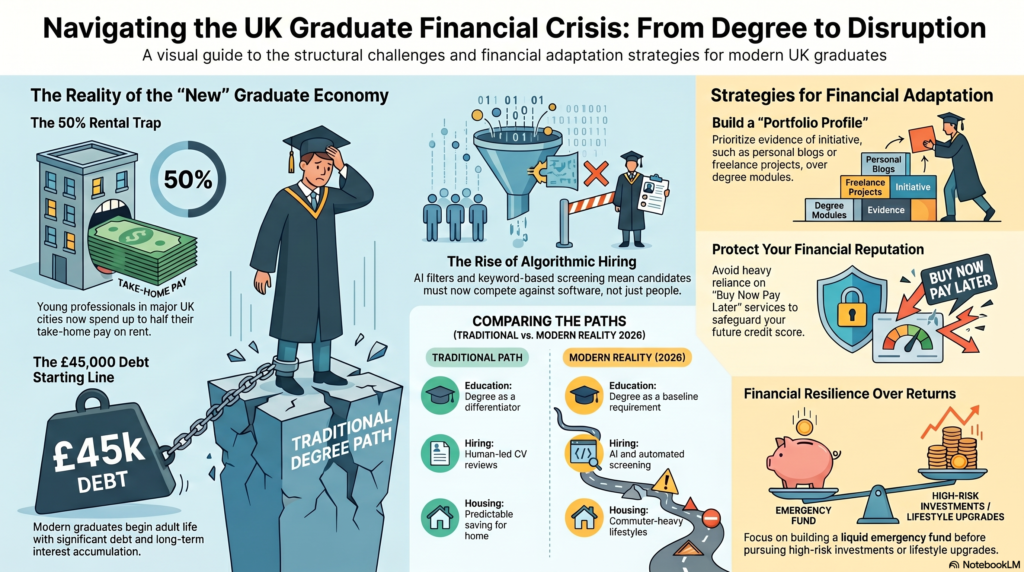
If you are a university student or recent graduate in the UK right now, it probably feels like the economic system is working against you.
For decades, young people were told a simple formula: Go to university, get a degree, work hard, and financial stability will follow.
But in 2026, that traditional pathway looks increasingly fragile. Today’s young generation faces a difficult combination of:
- rising living costs
- shrinking entry-level opportunities
- expensive housing
- student debt pressure
- growing financial uncertainty
As someone who spent over 25 years working in banking and financial services, I want to look beyond the headlines and explain what is really happening — and more importantly, how young people can adapt financially in this new economic reality.
🎓 The Graduate Job Market Has Changed
One of the biggest shocks facing graduates today is:
👉 a degree alone is no longer enough.
Years ago, earning a university qualification automatically helped applicants stand out.
Now:
- university attendance has expanded massively
- competition has intensified
- employers receive thousands of applications for limited graduate roles
As a result: many graduates feel overqualified yet underemployed.
The Rise of Automated Hiring
Another major shift is technology-driven recruitment.
Many companies now use:
- automated CV screening
- AI filtering systems
- keyword-based recruitment tools
This means applicants are no longer only competing against people — they are competing against algorithms. A strong candidate can be rejected before a human even reads the application.
Corporate Cost Cutting
Economic uncertainty has also affected graduate hiring.
Over recent years, many firms have:
- reduced graduate intakes
- frozen junior recruitment
- delayed hiring
- increased reliance on automation and AI tools
The jobs have not disappeared entirely —
but the entry barrier has become much higher.
💷 The Cost of Being Young Has Exploded
Even graduates who secure employment often face another challenge:
the cost of starting adult life.
Student Debt Pressure
Modern UK graduates can leave university with:
- £45,000+ of student debt
- long repayment periods
- interest accumulation
Under newer repayment structures, many graduates effectively face:
👉 an additional long-term deduction from their future income.
For some young workers, this feels less like a loan and more like a decades-long graduate tax.
The UK Rental Crisis
Housing costs have become one of the biggest financial pressures on young adults.
In cities such as:
- London
- Manchester
- Birmingham
- Bristol
rental prices have risen far faster than many graduate salaries.
The Harsh Reality
It is increasingly common for young professionals to spend:
- 40–50% of take-home pay
just on rent.
That leaves limited room for:
- savings
- investing
- emergencies
- home ownership goals
- pension contributions
Many young adults are working full-time yet still feel financially stuck.
📉 Why This Creates Long-Term Financial Stress
When most income disappears into:
- rent
- transport
- debt repayments
- utility bills
young people struggle to build:
- financial resilience
- emergency savings
- long-term wealth
This delays major life milestones such as:
- buying property
- starting families
- investing
- retirement planning
The psychological impact can also be significant.
🧠 The Financial Pressure Is Structural — Not Personal
This is important to understand. Many young people blame themselves for struggling financially. But much of today’s pressure comes from broader structural changes:
- housing shortages
- wage stagnation
- inflation
- labour market competition
- education costs
- economic uncertainty
This is not simply about “working harder.” The economic environment itself has changed dramatically.
💡 Bright Savings UK Guide: How Young People Can Adapt
Although the environment is challenging, there are still practical ways to improve financial positioning.
The modern economy rewards adaptability.
Strategy 1 — Build Skills Beyond Your Degree
A degree is now often the baseline, not the differentiator.
Employers increasingly value:
- practical experience
- digital skills
- evidence of initiative
Build a “Portfolio Profile”
Instead of relying purely on qualifications: show real work.
Examples:
- LinkedIn articles
- personal blogs
- freelance projects
- coding portfolios
- case studies
- social media projects
- financial analysis examples
Demonstrating capability often matters more than simply listing modules studied at university.
Strategy 2 — Consider Alternative Career Routes
Traditional university pathways are no longer the only option.
Degree apprenticeships and vocational pathways are becoming increasingly valuable.
Advantages can include:
- earning while learning
- reduced student debt
- corporate experience
- professional networking
- faster employability
In many sectors:
👉 experience now competes directly with academic credentials.
Strategy 3 — Protect Your Credit Record Early
One overlooked risk for young adults is damaging credit history early in life.
When money is tight, it becomes tempting to rely heavily on:
- Buy Now Pay Later services
- overdrafts
- credit cards
- payday-style borrowing
But financial mistakes made at 20 can affect opportunities at 30.
Why Credit History Matters
A poor credit file can affect:
- mortgage applications
- renting property
- phone contracts
- car finance
- future borrowing costs
Think of your credit profile as:
👉 your financial reputation.
Protect it carefully.
Strategy 4 — Avoid Lifestyle Inflation Early
Social media creates enormous pressure to appear financially successful.
Many young adults feel pressured to:
- travel constantly
- upgrade phones
- finance cars
- spend heavily socially
- maintain expensive lifestyles
But appearances and wealth are not the same thing.
Learning to live below your means early in life creates enormous long-term financial advantages.
Strategy 5 — Build an Emergency Fund First
Before investing heavily: focus on stability.
Even modest savings provide:
- flexibility
- reduced stress
- protection from financial shocks
An emergency fund is often more valuable than chasing high investment returns too early.
The Banker’s Perspective
After decades working in financial services, here is something I strongly believe:
👉 The financial challenges facing UK youth are real.
This generation is entering adulthood during:
- higher living costs
- greater competition
- weaker affordability
- economic instability
But adaptability matters. The young people who succeed financially today are often those who:
- continuously learn
- build practical skills
- manage debt carefully
- protect their financial health early
- think long term
Final Thoughts
Being young in the UK today is financially harder than many previous generations realise.
The traditional roadmap:
- university
- graduate job
- home ownership
- financial stability
has become far less predictable. But while the environment is difficult, young people are not powerless.
Small decisions made early — around debt, saving, spending, and skill-building — can still create powerful long-term advantages.
In many ways, financial resilience has become one of the most important modern life skills.
Bright Savings UK Tip
Do not compare your financial beginning to someone else’s middle. Building financial stability today often takes:
- patience
- adaptability
- discipline
- realistic expectations
Long-term financial success is still possible — but the path now requires smarter planning than ever before.
Why Trust Bright Savings UK?
Bright Savings UK is run by a former banker with over 25 years of experience in the banking and financial services industry. Our goal is to help everyday people save smarter, with clear explanations and practical guidance.
Suggested Internal Links
- How to Use the Financial Snowball Effect to Build Wealth [Link]
- The £1,000 Trap: Why Saving Feels Harder Than Ever and the 2026 Strategy to Finally Break Free [Link]
- How a UK Students Earn £200 to £800 a Month by Side Hustles in 2026 [Link]
How We Monetize This Site
To support the research and running of Bright Savings UK, we use two primary methods of monetization:
- Affiliate Links: Some links on this site are affiliate links. If you click and open an account, we may receive a commission. This does not change the price or terms you receive from the provider.
- Display Advertising: We host third-party advertisements through Google AdSense. We do not directly control the specific products shown in these ad units, and their presence does not constitute an endorsement by Bright Savings UK.
Disclaimer
Disclaimer: This article is for educational purposes only and does not constitute financial advice. Investing involves risk. Capital is at risk, and you may lose money. Always review provider terms directly before applying.