
Why Banks Love People Who Don’t Understand Interest Rates
Transparency Disclosure: To keep our guides free for everyone, this post contains affiliate links and display advertisements. If you click an affiliate link and sign up, we may earn a commission at no extra cost to you. As an ex-banker with 25 years of experience, I only recommend tools that I believe provide genuine value to your financial health. Read our full Affiliate Disclosure here.
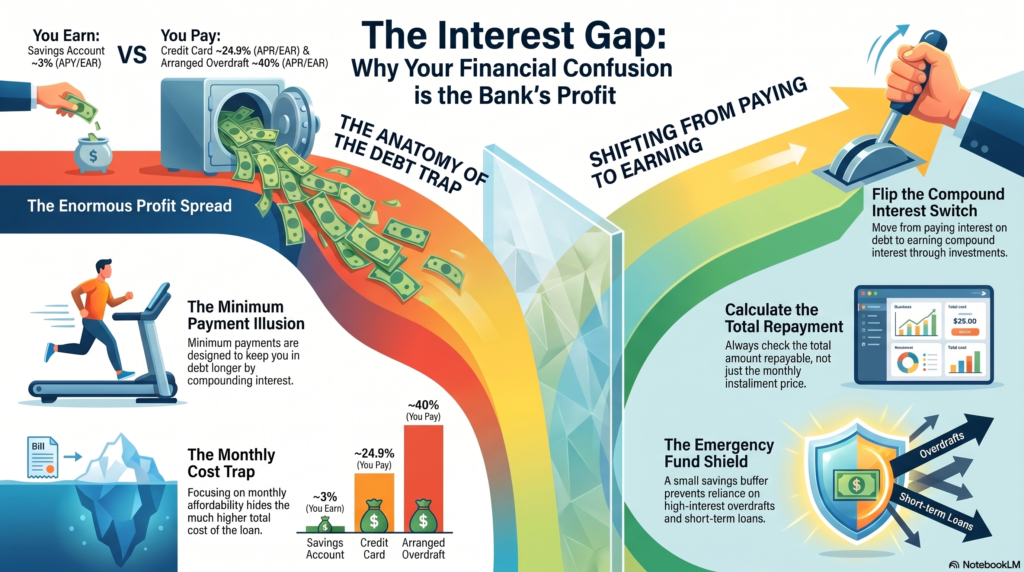
The hidden cost of financial confusion — and how understanding interest can save you thousands.
Most people think banks make money by “holding” your cash safely. That’s only part of the story.
The real engine of banking profits is interest — especially from customers who don’t fully understand how it works.
Every year, millions of people in the UK pay far more than they expect in credit card charges, overdraft fees, loans, and buy-now-pay-later schemes simply because they misunderstand interest rates. And while that confusion hurts consumers, it quietly boosts bank profits.
Understanding interest rates is one of the most important financial skills you can learn — yet it’s rarely taught properly in schools.
This article breaks down why interest matters, how banks profit from misunderstanding, and how you can use the same system to your advantage instead of working against yourself.
The Business Model Most People Never Think About
Banks operate on a simple principle:
- They pay you a low interest rate to keep your money.
- They lend that money out at a much higher interest rate.
- The difference becomes profit.
For example:
- A savings account may pay you 3% interest.
- A credit card may charge 24% APR.
- A personal loan may charge 8–15%.
That gap is enormous.
But here’s the key point:
Banks earn the most money from customers who carry debt for long periods and only make minimum repayments.
In other words, financial confusion is profitable.
The Dangerous Power of “Minimum Payments”
One of the biggest traps in personal finance is the minimum payment on credit cards.
It sounds manageable.
Maybe:
- £25 per month
- £40 per month
- “Just cover the minimum”
But minimum payments are designed to keep people in debt longer.
Example:
Suppose you owe:
- £3,000 on a credit card
- 24.9% APR
- Minimum repayment: 2%
You might think:
“That’s affordable.”
But the reality is very different.
You could spend YEARS repaying the balance and pay thousands in interest.
Here’s why compound interest works against borrowers.
Compound Interest Formula
A = Final amount after interest
P = Principal (starting amount)
r = Annual interest rate
n = Number of times interest is compounded yearly
t = Number of years
Example
If you invest £1,000 at 5% annual interest for 20 years:
Understanding compound interest is one of the most powerful financial skills you can learn.
Why APR Confuses So Many People
APR stands for Annual Percentage Rate.
But many consumers don’t actually understand what that means in practice.
Banks and lenders often advertise:
- “0% for 12 months”
- “Low monthly repayments”
- “Affordable finance”
- “Spread the cost”
The focus is usually on the monthly payment — not the total repayment.
That’s intentional.
People naturally think short-term:
- “Can I afford this monthly payment?”
instead of: - “How much will this cost me overall?”
That psychological gap is where lenders make money.
Buy Now, Pay Later: The New Debt Machine
Services like Klarna and Clearpay made borrowing feel casual.
Instead of feeling like debt, purchases feel:
- small,
- flexible,
- and painless.
But repeated small debts add up quickly.
Many people now juggle:
- credit cards,
- BNPL repayments,
- overdrafts,
- car finance,
- and personal loans all at once.
The issue isn’t always irresponsibility.
Often, it’s simply not understanding how interest and repayment structures work together.
Overdrafts: The Quiet Profit Generator
Many UK consumers still treat overdrafts like “extra money.” They’re not.
An overdraft is one of the most expensive forms of borrowing. Some arranged overdrafts charge nearly 40% EAR equivalent.
That means a temporary shortfall can become surprisingly expensive.
Banks know many customers:
- don’t read the terms,
- don’t compare rates,
- and don’t calculate the real cost.
So overdrafts remain hugely profitable.
The Wealth Gap Is Often an Interest Gap
One of the biggest differences between wealthy people and financially struggling people is this:
Struggling people often PAY compound interest.
Wealthy people often EARN compound interest.
That single shift changes everything.
For example:
- Credit card debt compounds against you.
- Investments compound for you.
- Savings accounts generate interest.
- Stocks and ETFs reinvest returns over time.
The financially educated learn to move from:
paying interest to: collecting interest.
Why Financial Education Matters More Than Ever
The modern economy is built on credit.
You can now borrow money instantly for:
- phones,
- furniture,
- holidays,
- clothes,
- subscriptions,
- and even takeaway food.
But easy borrowing creates long-term consequences.
Without understanding:
- APR,
- compound interest,
- repayment structures,
- and debt costs,
many people slowly lose financial control without realising it.
That’s why financial literacy matters more than income alone.
A high earner with poor money habits can still become trapped in debt.
Meanwhile, someone with average income but strong financial discipline can steadily build wealth.
How to Protect Yourself
Here are practical ways to avoid the interest trap:
1. Always Check the APR
Never focus only on monthly payments.
Look at:
- total repayment,
- interest rate,
- and loan length.
2. Avoid Carrying Credit Card Balances
If possible, pay the full balance monthly.
Credit cards are useful tools — but expensive debt if misused.
3. Build an Emergency Fund
Savings reduce reliance on overdrafts and high-interest borrowing.
Even £500–£1,000 can prevent many financial emergencies from becoming debt problems.
4. Learn Basic Compound Interest
Understanding how money grows — or how debt grows — changes financial behaviour dramatically.
Why Interest Rates Matter
Adjust the interest rates below and see how debt and investments grow over time.
£1000
5%
25%
20 years
Investment Growth
If you INVEST your money:
£
Debt Growth
If you OWE this money:
£
The same compound interest system that builds wealth for investors can destroy wealth for borrowers.
This simple concept explains why investing early matters so much.
5. Question “Affordable Monthly Payments”
Low monthly costs can hide extremely expensive long-term borrowing.
Always calculate the total cost.
Final Thoughts
Banks are not evil. They are businesses. And like any business, they profit from customer behaviour.
The problem is that many people enter adulthood without understanding:
- how interest works,
- how debt compounds,
- or how lenders structure repayments.
That lack of knowledge becomes expensive. The good news is that financial literacy is learnable. Once you understand how interest works, you start seeing money differently:
- debt becomes more dangerous,
- saving becomes more rewarding,
- and investing becomes more powerful.
The financial system rewards people who understand the rules.
So the question is: Are you paying interest — or earning it?
Why Trust Bright Savings UK?
Bright Savings UK is run by a former banker with over 25 years of experience in the banking and financial services industry. Our goal is to help everyday people save smarter, with clear explanations and practical guidance.
Suggested Internal Links
- Inflation, Interest Rates, and Your Savings: What UK Savers Need to Know (2026) [Link]
- What Is Interest? Simple Interest, Compound Interest & Why It Matters [Link]
- Risk vs. Opportunity: How to Manage Both at Every Stage of Life [Link]
How We Monetize This Site
To support the research and running of Bright Savings UK, we use two primary methods of monetization:
- Affiliate Links: Some links on this site are affiliate links. If you click and open an account, we may receive a commission. This does not change the price or terms you receive from the provider.
- Display Advertising: We host third-party advertisements through Google AdSense. We do not directly control the specific products shown in these ad units, and their presence does not constitute an endorsement by Bright Savings UK.
Disclaimer
Disclaimer: This article is for educational purposes only and does not constitute financial advice. Investing involves risk. Capital is at risk, and you may lose money. Always review provider terms directly before applying.