
UK Mortgage & Remortgage Rates Update – September 2026
Transparency Disclosure: To keep our guides free for everyone, this post contains affiliate links and display advertisements. If you click an affiliate link and sign up, we may earn a commission at no extra cost to you. As an ex-banker with 25 years of experience, I only recommend tools that I believe provide genuine value to your financial health. Read our full Affiliate Disclosure here.
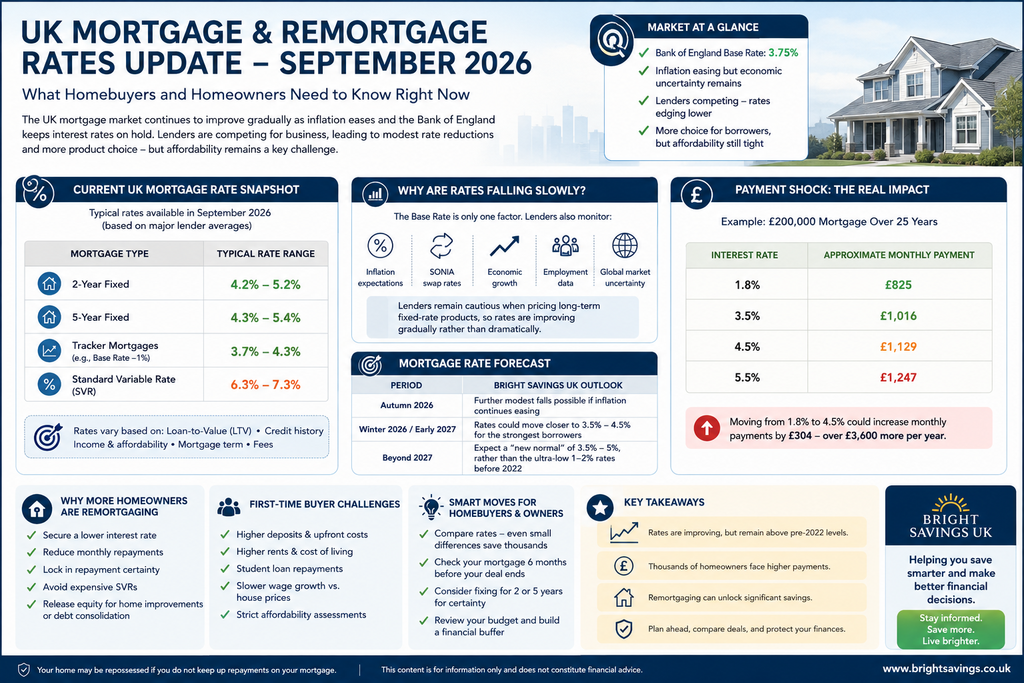
What Homebuyers and Homeowners Need to Know Right Now
The UK mortgage market enters September 2026 on a more uncertain footing. Mortgage rates had eased through the summer, but a renewed rise in wholesale funding and swap rates has put upward pressure on fixed-rate pricing. The Bank of England has kept Bank Rate at 3.75% since July, while lenders continue to compete for borrowers.
Borrowing costs remain well above the exceptionally low levels seen before 2022. Although there is still a wide choice of mortgage products, affordability remains a key challenge for first-time buyers and homeowners approaching remortgage.
Whether you’re buying your first home, moving house or approaching the end of a fixed-rate deal, understanding the latest mortgage trends can help you avoid unnecessary costs and prepare for rate changes.
Current UK Mortgage Rate Snapshot
Mortgage pricing is currently more volatile than it was in July. Moneyfacts data updated on 2 September shows average two-year and five-year fixed rates of 5.59% and 5.63% respectively. Meanwhile, Rightmove reported an average two-year remortgage rate of 5.42% on 2 September, with the lowest remortgage rates below 5% available to some borrowers depending on LTV and eligibility.
Typical Mortgage Rates – September 2026
| Mortgage Type | September 2026 Snapshot |
| 2-Year Fixed | 5.59% average |
| 5-Year Fixed | 5.63% average |
| Tracker Mortgages | 4.49% average (latest Moneyfacts data) |
| Standard Variable Rate (SVR) | 7.13% average |
Rates continue to depend on several factors:
- Loan-to-Value (LTV)
- Credit history
- Income and affordability
- Mortgage term
- Product and arrangement fees
Borrowers with larger deposits (25% or more) and strong credit records continue to receive the most competitive offers.
Why Are Mortgage Rates Rising Again?
The Bank of England Base Rate remains at 3.75%, but fixed mortgage pricing depends on much more than the Base Rate alone. Recent increases in swap rates and gilt yields have put renewed upward pressure on fixed-rate mortgages.
Lenders also monitor:
- Inflation expectations
- SONIA swap rates
- Economic growth
- Employment data
- Global market uncertainty
This means borrowers should not assume that mortgage rates will continue falling steadily. Fixed-rate pricing can move quickly when wholesale markets change, even if the Bank of England leaves Bank Rate unchanged.
Mortgage Rate Forecast
The outlook for the remainder of 2026 has become more uncertain. While inflation remains an important driver of monetary policy, higher energy costs, geopolitical risks and rising wholesale rates could keep mortgage pricing elevated or push some fixed rates higher in the near term.
Bright Savings UK Outlook
| Period | Bright Savings UK Outlook |
| September 2026 | Fixed rates may remain volatile, with upward pressure from higher swap rates |
| Autumn 2026 | Rates could stay elevated or rise if inflation and wholesale funding costs remain high |
| Early 2027 | Potential for improvement if inflation eases and wholesale rates stabilise |
The key message for borrowers is that the previous expectation of a smooth decline in mortgage rates should be treated cautiously. Rates may remain around current levels or rise before any later improvement. Borrowers with a mortgage ending within the next six months should compare options early rather than waiting for rates to fall.
Challenges Facing First-Time Buyers
Despite improving mortgage availability, buying a first home remains difficult.
For a property costing £300,000, buyers typically still need:
- £30,000 deposit (10%)
- Legal fees
- Stamp Duty (where applicable)
- Survey costs
- Moving expenses
Many prospective buyers continue to struggle with:
- Higher rents
- Cost of living pressures
- Student loan repayments
- Slower wage growth compared with house prices
Mortgage affordability assessments also remain stricter than before the inflation crisis, limiting the amount many buyers can borrow.
Existing Homeowners Continue to Face Payment Shock
A large number of homeowners continue to move from older fixed-rate deals into a market where typical borrowing costs are materially higher than the rates available before 2022.
Example: £200,000 Mortgage Over 25 Years
| Interest Rate | Approximate Monthly Payment |
| 1.8% | £828 |
| 3.5% | £1,001 |
| 5.59% | £1,239 |
| 7.13% | £1,430 |
A homeowner moving from 1.8% to the current average two-year fixed rate of about 5.59% could see repayments rise by roughly £411 per month, or almost £4,940 per year, on this illustrative £200,000 mortgage.
This example is illustrative only. Actual payments depend on the remaining balance, mortgage term, fees and the rate offered to the individual borrower.
Why More Homeowners Are Remortgaging
As lenders compete for business, remortgaging remains important, but the recent rise in wholesale rates makes early preparation even more valuable.
Potential benefits include:
- Securing a lower interest rate
- Reducing monthly repayments
- Locking in repayment certainty
- Avoiding expensive Standard Variable Rates
- Releasing equity for renovations or debt consolidation
Many borrowers can reduce the risk of payment shock by reviewing their options several months before their existing deal expires and comparing the total cost of available products.
2-Year Fixed or 5-Year Fixed?
2-Year Fixed
Advantages
- Greater flexibility
- Opportunity to benefit if rates fall later
Disadvantages
- Need to remortgage again sooner
- Greater exposure to market changes
5-Year Fixed
Advantages
- Long-term payment certainty
- Protection against future rate increases
- Easier household budgeting
Disadvantages
- Less flexibility
- Early repayment charges may apply
The best choice depends on your personal finances, career plans and attitude towards interest-rate risk.
Tips for Securing a Better Remortgage Deal
Start Early
Many lenders allow borrowers to secure a new mortgage up to six months before their existing deal expires.
Improve Your Credit Score
Maintaining a strong credit profile can unlock lower rates and increase lender choice.
Compare Total Costs
Don’t focus solely on the headline interest rate. Product fees, valuation fees and cashback incentives can significantly affect the true overall cost.
Compare the Whole Market
Independent mortgage brokers often have access to exclusive deals unavailable directly from lenders.
Look for Cashback Offers
Some remortgage products include cashback that can help cover legal fees, valuation costs or moving expenses.
👉 Cashback Remortgages UK – Compare Remortgage Deals and Cashback Offers
(Affiliate link – if you apply through this link, Bright Savings UK may receive a commission at no extra cost to you.)
Bright Savings UK View
The UK mortgage market is entering September with a very different message from July: rates are no longer moving only in one direction. Average fixed mortgage rates are around 5.6%, while renewed volatility in swap rates could lead lenders to reprice products.
The Bank of England Base Rate remains at 3.75%, but fixed mortgage rates are influenced by wholesale funding markets, gilt yields and swap rates. Recent market movements mean borrowers should be prepared for both higher and lower rates rather than assuming a continued downward trend.
For anyone whose fixed-rate mortgage ends within the next six months, now is a good time to start comparing deals. Securing a mortgage offer early can provide protection against further rate increases, while some lenders may allow borrowers to switch to a cheaper product if rates improve before completion.
Preparation, comparison and early action remain the most effective ways to manage borrowing costs in a volatile mortgage market.
Key Takeaways
✅ Average two-year and five-year fixed mortgage rates are around 5.59% and 5.63% respectively.
✅ The Bank of England Base Rate remains at 3.75%, with the next scheduled decision on 17 September 2026.
✅ Rising swap rates and gilt yields could put upward pressure on fixed mortgage rates.
✅ First-time buyers continue to face affordability challenges, particularly at higher LTVs.
✅ Existing homeowners should begin remortgaging up to six months before their current deal expires.
✅ Borrowers should compare total costs and consider securing a deal early if rates may rise.
Why Trust Bright Savings UK?
Bright Savings UK is run by a former banker with over 25 years of experience in the banking and financial services industry. Our goal is to help everyday people save smarter, with clear explanations and practical guidance.
Suggested Internal Links
- What Type of Investor Are You? A UK Guide to Risk Tolerance & Smarter Wealth Building [Link]
- Be Water: A Timeless Philosophy for Building Wealth [Link]
- Risk vs. Opportunity: How to Manage Both at Every Stage of Life [Link]
How We Monetize This Site
To support the research and running of Bright Savings UK, we use two primary methods of monetization:
- Affiliate Links: Some links on this site are affiliate links. If you click and open an account, we may receive a commission. This does not change the price or terms you receive from the provider.
- Display Advertising: We host third-party advertisements through Google AdSense. We do not directly control the specific products shown in these ad units, and their presence does not constitute an endorsement by Bright Savings UK.
Disclaimer
Disclaimer: This article is for educational purposes only and does not constitute financial advice. Investing involves risk. Capital is at risk, and you may lose money. Trading CFDs and leveraged products carries risk and may not be suitable for all investors. Always review provider terms directly before applying.