
How to Apply for a Mortgage in the UK as a Young First-Time Buyer
Transparency Disclosure: To keep our guides free for everyone, this post contains affiliate links and display advertisements. If you click an affiliate link and sign up, we may earn a commission at no extra cost to you. As an ex-banker with 25 years of experience, I only recommend tools that I believe provide genuine value to your financial health. Read our full Affiliate Disclosure here.
The dream of homeownership can feel incredibly distant. House prices are steep, rent eats up a massive chunk of your monthly income, and lenders are far stricter than they used to be.
The biggest hurdle for most young buyers isn’t making the monthly payments—it’s scraping together the deposit and passing the brutal affordability checks. But here is the good news: thousands of young people still buy their first homes every single month. The secret is knowing how lenders think and prepping your finances long before you apply.
Why the Market is Tough (The Hard Truth)
Understanding what you are up against is the first step to beating it. Lenders are looking at far more than just a multiple of your salary.
- The Deposit Mountain: Lenders generally require a minimum 5% deposit. On a £250,000 home, that is £12,500. A safer 10% deposit jumps to £25,000.
- The Affordability Squeeze: Lenders will comb through your bank statements to assess your “committed expenditure.” This includes student loans, car finance, credit card balances, and even Buy Now, Pay Later (BNPL) habits.
- The Reality of Rates: Gone are the days of 1.5% interest rates that previous generations enjoyed. While rates have stabilized from their recent peaks, buyers must still prove they can “stress-test” their finances to afford payments if rates rise even higher.
The Step-by-Step Application Journey
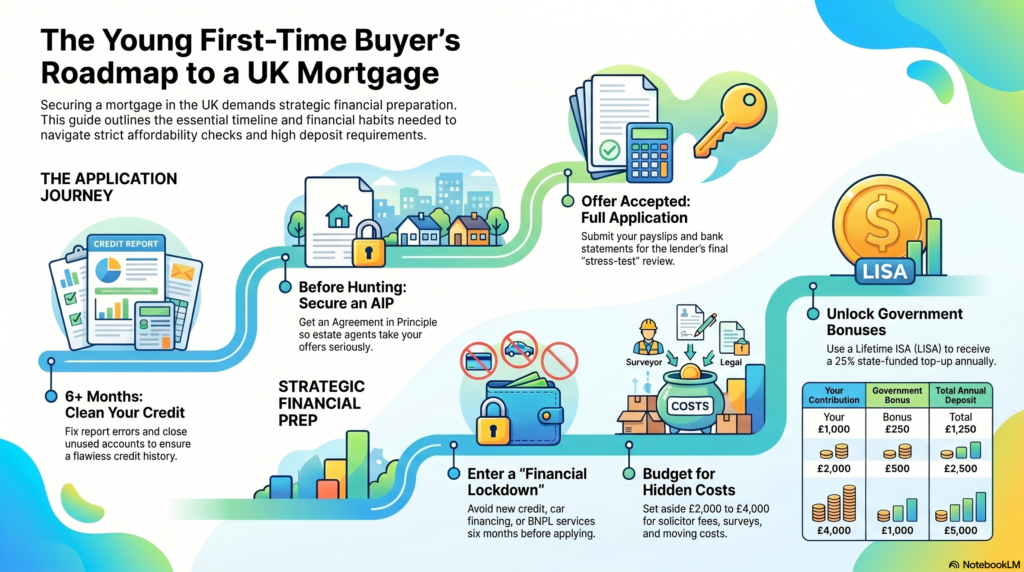
When order is critical, missing a step can result in a rejected application. Follow this timeline to get mortgage ready.
1.Check Your Credit Report: 6+ Months Before.
Grab your reports from Experian, Equifax, and TransUnion. Fix any address mismatches, close old unused accounts, and dispute any errors immediately.
2.Supercharge the Deposit: Ongoing.
Aim for a minimum of 5% but know that hitting 10% or 15% unlocks significantly lower interest rates and cheaper monthly repayments.
3.Get an Agreement in Principle (AIP): Before House Hunting.
An AIP is an official nod from a lender showing how much they are likely to let you borrow. Estate agents will rarely take your offers seriously without one.
4.Account for the ‘Hidden’ Costs: While browsing.
Don’t spend every penny on the deposit. Budget an extra £2,000 to £4,000 for solicitor fees, property surveys, moving costs, and essential furnishing.
5.Submit the Full Application: Offer Accepted.
Hand over your paperwork (payslips, bank statements, ID, and proof of deposit). The lender will then run a hard credit check and value the property.
Smart Financial Moves You Should Make Early
To present yourself as the “perfect borrower,” you need to adopt a lender’s mindset.
1. Maximize the Lifetime ISA (LISA)
If you are aged 18 to 39, this is free money from the government. You can put in up to £4,000 per year, and the state tops it up with a 25% bonus.
| Your Contribution | Government Bonus | Total Annual Deposit |
| £1,000 | £250 | £1,250 |
| £2,000 | £500 | £2,500 |
| £4,000 | £1,000 | £5,000 |
2. Implement a “Financial Lockdown”
In the six months leading up to your application, do not take out new credit. Avoid financing a new car, taking out personal loans, or using BNPL services. Lenders view sudden credit spikes right before a mortgage application as a major red flag.
3. Clear Existing Debt
Every pound you owe in credit card debt or car loans directly reduces your borrowing power. Prioritize paying down clearable debts to boost your maximum loan amount.
4. Consider a Team Effort
Buying with a partner or a trusted friend instantly doubles your buying power. Two incomes make passing the affordability checks vastly simpler, though ensure you have a legal agreement (like a Deed of Trust) drawn up by your solicitor to protect both of your shares.
💡 The Banker’s Perspective
“Lenders aren’t just looking for high earners; they are looking for financial stability. A young applicant earning £35,000 with a flawless credit history and a consistent savings habit is often much easier to approve than someone earning £60,000 who carries heavy debts and has irregular, impulsive spending habits.”
Crucial Pitfalls to Avoid
- ❌ Job Hopping: Try not to switch jobs or move from a permanent role to a probationary contract right before applying. Lenders prefer seeing at least 3–6 months of continuous employment.
- ❌ Emptying the Tank: Never spend your absolute last pound on the house purchase. Leave yourself a cash buffer for unexpected plumbing issues, broken appliances, or life emergencies.
- ❌ Overstretching: Just because a bank offers to lend you a specific amount doesn’t mean you should take all of it. Keep your monthly repayments at a level that still allows you to live comfortably.
Your Best Secret Weapon: A Mortgage Broker
Instead of walking into your local high street bank, use an independent mortgage broker. They have access to the entire market—including specialist first-time buyer deals and smaller building societies that you won’t find on price comparison websites. They do the heavy lifting, package your application perfectly, and drastically maximize your chances of a first-time approval.
Why Trust Bright Savings UK?
Bright Savings UK is run by a former banker with over 25 years of experience in the banking and financial services industry. Our goal is to help everyday people save smarter, with clear explanations and practical guidance.
Suggested Internal Links
- UK Mortgage & Remortgage Rates Update – June 2026 [Link]
- Dreams Don’t Come True by Waiting: A Guide for Students & Young Professionals [Link]
- Should You Buy a property or Invest in Stocks in the UK? (2026 Guide for Young Adults) [Link]
How We Monetize This Site
To support the research and running of Bright Savings UK, we use two primary methods of monetization:
- Affiliate Links: Some links on this site are affiliate links. If you click and open an account, we may receive a commission. This does not change the price or terms you receive from the provider.
- Display Advertising: We host third-party advertisements through Google AdSense. We do not directly control the specific products shown in these ad units, and their presence does not constitute an endorsement by Bright Savings UK.
Disclaimer
Disclaimer: This article is for educational purposes only and does not constitute financial advice. Investing involves risk. Capital is at risk, and you may lose money. Trading CFDs and leveraged products carries risk and may not be suitable for all investors. Always review provider terms directly before applying.