
UK Mortgage & Remortgage Rates Update – June 2026
Transparency Disclosure: To keep our guides free for everyone, this post contains affiliate links and display advertisements. If you click an affiliate link and sign up, we may earn a commission at no extra cost to you. As an ex-banker with 25 years of experience, I only recommend tools that I believe provide genuine value to your financial health. Read our full Affiliate Disclosure here.
What Homebuyers and Homeowners Need to Know Right Now
Mortgage rates remain one of the biggest financial concerns for UK households in 2026. While inflation has fallen significantly from its peak and interest rates have started to ease, borrowing costs remain much higher than many homeowners became accustomed to during the ultra-low-rate era.
Whether you’re a first-time buyer trying to get onto the property ladder, a homeowner coming to the end of a fixed-rate deal, or someone looking to reduce monthly payments through remortgaging, understanding the current mortgage market is essential.
In this monthly update, we look at where mortgage rates stand today, where they could be heading, and what practical steps borrowers can take to save money.
Current UK Mortgage Rate Snapshot
While lenders continue to compete aggressively for new business, mortgage rates remain sensitive to inflation data and market expectations.
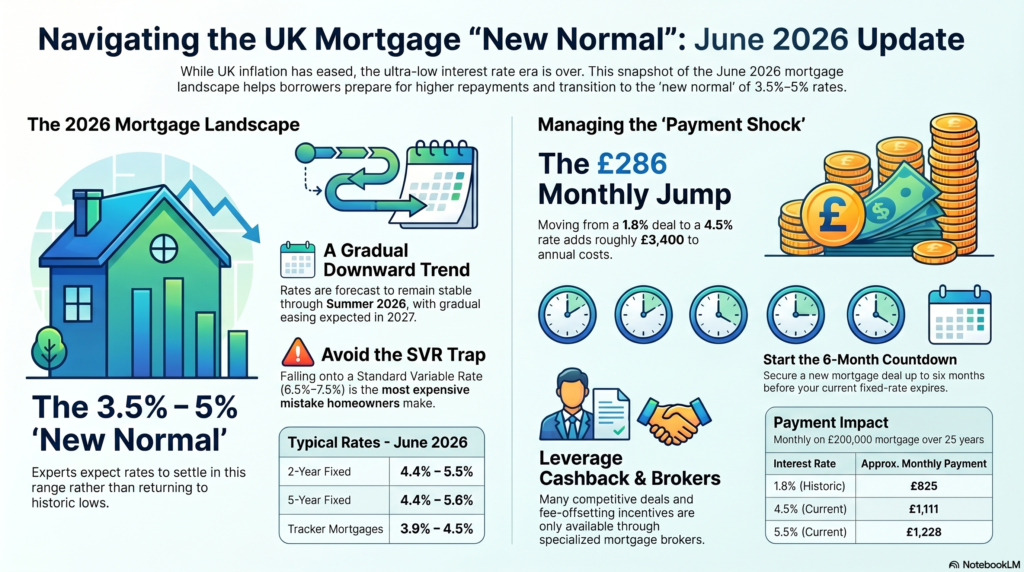
Typical Mortgage Rates – June 2026
| Mortgage Type | Typical Rate Range |
| 2-Year Fixed | 4.4% – 5.5% |
| 5-Year Fixed | 4.4% – 5.6% |
| Tracker Mortgages | 3.9% – 4.5% |
| Standard Variable Rate (SVR) | 6.5% – 7.5% |
Rates will vary depending on:
- Deposit size (Loan-to-Value ratio)
- Credit history
- Income and affordability
- Mortgage term
- Product fees
Borrowers with larger deposits and strong credit profiles continue to secure the most competitive rates.
Why Are Mortgage Rates Still Relatively High?
The Bank of England Base Rate currently stands at 3.75%, significantly lower than the peak reached during the inflation crisis. However, mortgage rates do not move in direct lockstep with the Base Rate.
Lenders also consider:
- Future inflation expectations
- Swap rates (the cost of wholesale funding)
- Economic growth forecasts
- Global energy prices
- Market uncertainty
Although the overall direction for interest rates appears downward, lenders remain cautious. This means mortgage rates are falling slowly rather than rapidly.
Mortgage Rate Forecast: What Could Happen Next?
Most economists now expect a gradual easing in mortgage rates rather than a dramatic drop.
Bright Savings UK Outlook
| Period | Forecast |
| Summer 2026 | Rates likely to remain relatively stable |
| Autumn 2026 | Small reductions possible if inflation remains under control |
| Early 2027 | Further gradual easing expected |
For many borrowers, the new normal is likely to be mortgage rates between 3.5% and 5% rather than the 1% to 2% rates seen before 2022.
While lower rates would be welcome news, borrowers should plan their finances based on realistic expectations rather than hoping for a return to historic lows.
The Challenges Facing First-Time Buyers
Buying a first home remains difficult despite signs that house price growth is slowing.
Saving a Deposit
For a £300,000 property, a 10% deposit requires £30,000 in savings.
Many aspiring homeowners continue to face:
- Rising rents
- Higher utility bills
- Student loan repayments
- Increased living costs
All of which make saving harder.
Mortgage Affordability Tests
Lenders continue to stress-test applications against higher hypothetical interest rates to ensure borrowers can cope with future increases.
As a result, many buyers discover they can borrow less than they expected.
House Prices Remain Elevated
Although some regions have experienced modest price corrections, affordability remains a major obstacle for younger buyers.
The Biggest Issue for Existing Homeowners: Payment Shock
Many homeowners fixed their mortgage at rates below 2% during 2020 and 2021.
As those deals come to an end, they are facing significantly higher repayments.
Example: £200,000 Mortgage Over 25 Years
| Interest Rate | Approximate Monthly Payment |
| 1.8% | £825 |
| 3.5% | £1,001 |
| 4.5% | £1,111 |
| 5.5% | £1,228 |
Moving from a 1.8% mortgage to a 4.5% mortgage could increase monthly repayments by around £286 per month — more than £3,400 per year.
For many households, this increase represents one of the largest financial challenges they have faced in recent years.
Why More Homeowners Are Remortgaging
Remortgaging has become one of the most effective ways to manage rising borrowing costs.
Benefits can include:
- Securing a lower interest rate
- Reducing monthly repayments
- Locking in repayment certainty
- Avoiding expensive Standard Variable Rates
- Releasing equity for home improvements or debt consolidation
Many borrowers could save thousands simply by reviewing their mortgage options before their current deal expires.
2-Year Fixed or 5-Year Fixed?
One of the most common questions homeowners face is whether to choose a shorter or longer fixed-rate deal.
2-Year Fixed Rate
Advantages
- Greater flexibility
- Potential to benefit from future rate reductions
Disadvantages
- Need to remortgage again sooner
- Greater exposure to market uncertainty
5-Year Fixed Rate
Advantages
- Long-term payment certainty
- Protection against future rate increases
Disadvantages
- Less flexibility
- Early repayment charges may apply
The best option depends on your financial situation, future plans and attitude towards risk.
Tips for Securing a Better Remortgage Deal
Start Early
Many lenders allow borrowers to secure a new mortgage up to six months before their current deal ends.
Improve Your Credit Profile
A stronger credit score can help unlock better rates.
Review Product Fees
The lowest advertised rate is not always the cheapest deal once arrangement fees are included.
Compare the Whole Market
Many competitive deals are only available through mortgage brokers.
Consider Cashback Offers
Some remortgage deals include cashback incentives that can help offset legal fees, valuation costs or moving expenses.
You can compare available remortgage options and cashback opportunities through our partner:
👉 Cashback Remortgages UK – Compare Remortgage Deals and Cashback Offers
(Affiliate link – if you apply through this link, Bright Savings UK may receive a commission at no extra cost to you.)
Bright Savings UK View
The UK mortgage market is far more stable than it was during the peak of the inflation crisis, but borrowers should remain realistic.
Mortgage rates are likely to continue drifting lower over time, but a return to the ultra-cheap borrowing costs of the past decade appears unlikely.
The most expensive mistake homeowners can make today is failing to plan ahead. Falling onto a lender’s Standard Variable Rate could increase borrowing costs dramatically and wipe out potential savings.
If your fixed-rate deal expires within the next six months, now is the ideal time to start exploring your options and securing a competitive replacement deal.
Key Takeaways
✓ Mortgage rates remain significantly higher than pre-2022 levels.
✓ Most experts expect gradual reductions rather than dramatic cuts.
✓ First-time buyers continue to face affordability challenges.
✓ Existing homeowners should prepare for higher repayments when fixed deals expire.
✓ Starting the remortgage process early can unlock better rates and avoid expensive SVRs.
✓ Cashback remortgage offers may provide additional savings when switching lenders.
Why Trust Bright Savings UK?
Bright Savings UK is run by a former banker with over 25 years of experience in the banking and financial services industry. Our goal is to help everyday people save smarter, with clear explanations and practical guidance.
Suggested Internal Links
- How to Prepare Your Finances Before Applying for Credit [Link]
- How Credit Scores Work in the UK (Beginner Guide 2026) [Link]
- Should You Buy a property or Invest in Stocks in the UK? (2026 Guide for Young Adults) [Link]
How We Monetize This Site
To support the research and running of Bright Savings UK, we use two primary methods of monetization:
- Affiliate Links: Some links on this site are affiliate links. If you click and open an account, we may receive a commission. This does not change the price or terms you receive from the provider.
- Display Advertising: We host third-party advertisements through Google AdSense. We do not directly control the specific products shown in these ad units, and their presence does not constitute an endorsement by Bright Savings UK.
Disclaimer
Disclaimer: This article is for educational purposes only and does not constitute financial advice. Investing involves risk. Capital is at risk, and you may lose money. Trading CFDs and leveraged products carries risk and may not be suitable for all investors. Always review provider terms directly before applying.